Well, I just returned from a relaxing week at the beach with the extended family (well, my wife's side, anyway). My usual practice at such retreats is to actually "do" as little as possible and such physical inactivity naturally creates a sort of "time vacuum" which reading tends to fill most welcomely.
I'm not generally prone to reading fiction, except science fiction and fantasy, but this summer proved to be an exception with only one of the four books I read coming anywhere close to the science fiction/fantasy genre:
The Last Witchfinder by James Morrow. Morrow's books tend to have a philosophic undertext that he illustrates through the telling of his stories. For example, his "Jehovah trilogy" (Towing Jehovah, Blameless in Abbaddon, & The Eternal Footman) sets a story of the death of God and the disposition of his two-mile-long corpse against a backdrop consisting of the Problem of Evil, the foundation of morality, and the meaning of life. I highly recommend them as thoughtful and engaging explorations of this philosophic topic and just as highly recommend this, his latest work.
Here's the basic plot (from School Library Journal by way of Amazon): England in the late 17th century is an exciting–if dangerous–home for Jennet Stearne, a teen whose family is a microcosm of the country's philosophical and religious conflicts. Though she is enthralled by Isaac Newton's theories and her progressive Aunt Isobel's scientific experiments, she also takes pride in her father, Walter, who is a highly regarded professional witch-hunter. Jennet's filial piety and belief system are overturned abruptly when blameless Isobel is burned at the stake because Walter labels her a witch. The girl vows to prevent other unjust executions by using science to prove witchcraft nonexistent. Her stubborn quest goes on for decades, leading her into wild adventures that include being captured by pirates, becoming an adoptive Native American, witnessing the Salem witch craze, and carrying on an affair with the young Ben Franklin. Jennet and her companions dash through an energetic narrative that re-creates the period believably, thanks to the author's admirable linguistic and historical research. While the protagonist is an appealing character, the real star is Newton's Principia Mathematica, whose amusing commentary provides a new twist to notions about the power and endurance of the printed word.
Yes, it really is as interesting as it sounds and Morrow's ability to weave history and fantasy together in his engaging narrative style makes this book a real pleasure to read as well.
17 July, 2006


26 May, 2006
Some thoughts on Euthyphro
Plato's Euthyphro is truly one of the great classics of philosophy. In this post I want to offer some general thoughts on its central argument as a prelude to a later post exploring a particular epistemological concern and its relationship to Euthyphro's dilemma.
In the dialogue Socrates and Euthyphro discuss the nature of holiness, arriving finally at the well-known ( among philosophers and students of philosophy, anyway!) dilemma:
Although Socrates and Euthyphro are discussing "holiness", the dilemma is extendable to other concepts, most commonly that of good:
But rather than solving the dilemma, this sort of brings us right back to it. Even in this more sophisticated version of DC, there would seem to be no epistemic difference between "God commands that which is good, based on his nature" and "God's commands are good." This is so because we have no independent means of verifying that God's commands reflect something external to His will (His nature) and thus, epistemically speaking, both versions are really equivalent.
There are certainly other means of grounding morality in God's nature, but the theist intent on paring this grounding with the certification of God's alleged commands as "good" regardless of any external verification would seem to have to deal with Euthyphro's dilemma.
In the dialogue Socrates and Euthyphro discuss the nature of holiness, arriving finally at the well-known ( among philosophers and students of philosophy, anyway!) dilemma:
- Are things holy because they are loved by the gods?
- Or are things loved by the gods because they are holy?
Although Socrates and Euthyphro are discussing "holiness", the dilemma is extendable to other concepts, most commonly that of good:
- Is "good" that which is commanded by God?
- Or are things commanded by God because they are good?
But rather than solving the dilemma, this sort of brings us right back to it. Even in this more sophisticated version of DC, there would seem to be no epistemic difference between "God commands that which is good, based on his nature" and "God's commands are good." This is so because we have no independent means of verifying that God's commands reflect something external to His will (His nature) and thus, epistemically speaking, both versions are really equivalent.
There are certainly other means of grounding morality in God's nature, but the theist intent on paring this grounding with the certification of God's alleged commands as "good" regardless of any external verification would seem to have to deal with Euthyphro's dilemma.
Of Consorts and Concerts...
I haven't posted about it before, but my Bachelor's degree (from UNCG) is in music. My main instrument was voice (tenor), but I also studied keyboard instruments (organ, piano, harpsichord) and composition. I have continued to pursue music as an avocation and for the last two decades have been singing with the Bel Canto Company as well as occasionally filling in as a substitute organist or chorister/soloist at various local churches.
Well, this year some friends and I struck out on our own and formed a vocal ensemble dedicated to music of the Mediaeval, Renaissance, & early Baroque periods. The group is called the Kensington Consort and so far this year we've had two performances, both in Greensboro. There will be at least one more, on June 9th in Burlington. Details are available at our web site.
Additionally, just this day I was asked to join a small group that will perform at the Magnolia Baroque festival, held in Winston-Salem. I'll be singing on the June 22d concert in some Monteverdi madrigals and on the June 24th concert as part of the chorus in Vivaldi's Gloria. Details are available at the Magnolia Baroque website.
If you're in the Burlington or Winston-Salem areas, please do attend one of these concerts. I guarantee you won't be disappointed!
17 May, 2006
Natural Law and Gay Marriage
I've said it before: I love Positive Liberty. Jon Rowe has a post up discussing the Roman Catholic Church's use of Natural Law against the concept of gay marriage. The author he cites couldn't be more right: Catholic theologians and pundits have become adept at claiming NL foundations for their arguments contra abortion, birth control, homosexuality, and a host of other human realities, but they often appear to be so immersed in their Thomistic construction of NL that they utterly forget that his was an interpretation of a far older (and pagan!) ideal. Aristotle is the most famous proponent and we would be hard pressed indeed to attempt to use Aristotleian NL in the manner in which Catholic prelates and theologians do.
For both Aristotleian and Thomistic NL, the telos of an existent is what informs the morality of its agency or use. But the argument as pressed against gay marriage fails because the Thomistic construction (or, at least as it appears often to be used) relies too heavily on biology as an indicator of teleology. To be sure, the proponents will deny that this is what they are doing. They will point to Biblical and Church-traditional rationales that support the ideal of a man-woman relationship as somehow metaphysically required or superior. By doing so they effectively deny any possibility of a metaphysical telos for the homosexual, summarily declaring him or her as acting outside of proper function. But if "proper function" is metaphysically, not biologically, determined, upon what rationale does their declaration rest? The only way they can justify it is to turn to some form of revelation, but doing so negates their claim to be basing their argument on NL.
John Corvino, the author whom Rowe cites, exposes this flaw in their reasoning by calling attention to the blatant inconsistency with which the Church will endorse non-procreative heterosexual sex but condemn non-procreative homosexual sex. As this forms part of a common argument one finds against gay marriage (from non-Catholics as well), it's good to see an explicit calling-out of this hypocrisy. Corvino writes:
Why the apparent inconsistency? Catholic natural law theorists answer that such acts can still be of “the reproductive kind.” But it is difficult to make sense of this claim, except as a lame attempt to deny unpalatable conclusions that clearly follow from the Church’s position. If a sexual act cannot result in procreation and the couple knows it, then how is the act “of the reproductive kind”?Indeed. "Lame" is an excellent word to describe this misleading and dishonest tactic. I agree with Rowe when he further points out:
In many ways, the Catholic position on sex is downright immoral and irresponsible. Even married couples can only handle so many children at once. Couples ought not bring more children into a family than they can responsibly handle. There are some couples, those on the right end of the fertility Bell Curve, who will literally have over a dozen children in a lifetime marriage. And for most couples, excluding the Bill Gates and Donald Trumps who could not only support all the children but hire as many nannies as needed to assist the wife, that’s just a bad, irresponsible life-plan to say the least.Catholics obviously rely on God to sort it all out; to ensure that children aren't born to families that cannot care for them. I'm sure that works just fine for celibate clergy, but over here in the real world family planning isn't just a good idea; it's a moral necessity. The telos of procreative sex need not necessarily include overpopulating the world and neither need the telos of sex itself be procreative.
16 May, 2006
Minor Changes...
I'd like to start utilizing trackbacks, but unfortunately Blogger doesn't support them, so I've added Haloscan commenting and trackback to my blog. I've also turned on the Blogger "link" feature, so I'll be able to utilize Blogger links as well as trackbacks. Of course, that is assuming anyone ever reads this thing...
15 May, 2006
Easiest Book Review EVER!

If I invoke Godwin's Law, can I get out of reading this book?
It it even necessary to read this book in order to review it? What type of author expects to be taken seriously when the cover of his book equates its target with Hitler?
Did "Liberals" murder six million people? Did "Liberals" invade sovereign nations without cause? did "Liberals" drag the world into a war of conquest that cost the lives of millions of innocents?
Is there anything resembling intellectual honesty left in the world of right-wing punditry?
This type of blatant demonization has become an all-too-familiar tactic of the extreme right. I see it in the Op-Ed pages of newspapers & magazines, see it on television, hear it on the radio, and read it in conservative blogs. The level of political discourse in this nation was never all that high, but it's declined considerably in the last two decades or so. I keep hoping that at some point Americans will rise up in disgust, recognize the power-hungry cynicism that feeds this manipulative and degrading approach and reject it utterly. But, as Barnum said, no one ever went broke underestimating the American public...
On a bright note: Ann Coulter can relax. Although a close second, she is apparently no longer the whackiest Conservative shill on the block...
(HT: Andrew Sullivan)
04 May, 2006
Contra TAG
Almost a year ago I participated in a debate at TheologyWeb on the soundness of the Transcendental Argument for the Existence of God (TAG). Naturally, I took the negative (*wink*). Unfortunately, after the initial expositions, my opponent was unable to continue, but I still think my opening statement was a pretty good one:
Objectives
Expectations
When I first encountered this argument several years ago, I was quite taken with the novelty of its approach. Like Anselm’s Ontological Argument it appears quite convincing at first blush, but upon deeper reflection, the flaw at its heart becomes evident. It is my hope that this essay will allow me to explain and demonstrate why it is that I believe TAG to be not only unsound, but also self-defeating in exactly the same sense as TAG proponents claim non-Christian worldviews to be.
However, even assuming my utter success, it’s important to note that a defeat of TAG does not demonstrate the non-existence of the Christian God. In fact, given my philosophy of religion, I believe that TAG is more likely to be false if it is the case that God actually exists. I expect that my rationale for this will become clear as we proceed. At any rate, suffice it to say here that this essay is not about the existence of God, merely the soundness of this particular argument for His existence (although it is true that if I were to become convinced of the soundness of TAG, I would appear to have no rational grounds to deny God’s existence).
Burden of Proof
Tthe primary component of TAG that its proponents assert (and one which I am attacking) is that no non-Christian worldview can provide sufficient warrant for human intelligibility. To meet their burden of proof, TAG proponents must therefore do one of two things:
1) Demonstrate that every possible worldview fails to meet the test(s) for warrant.
2) Demonstrate that it is impossible in principle for any worldview other than the Christian one to meet the tests for warrant.
Given that #1 would necessarily involve subjecting every possible worldview to the test(s) in question to see if they pass or fail, and given that there are hundreds if not thousands of possible worldviews (and would therefore seem highly unlikely if not impossible to accomplish), I will I will confine my discussion to #2. My job, therefore, is to provide reason to believe that whatever principle the TAG proponent might propose to vitiate non-Christian worldviews is insufficient to that task.
Therefore, in addition to demonstrating that TAG is itself unsound, in the course of these remarks I will also outline a positive case for a non-Christian worldview that provides sufficient warrant for the intelligibility of human experience, thus vitiating in principle any attack the TAG proponent might contend.
Assumptions
In the course of any discussion, there it is generally the case that both "sides" will make certain assumptions. In pressing my negative attack, I will attempt to make as few as possible, as the only necessity is to provide rational grounds to reject TAG. On the other hand, for my positive case I will adopt several of the key assumptions made by TAG proponents. In particular, the argument rests upon an assumption of some form of realism: the belief that reality is in some sense objective. That is, existents are instantiated and sustained external to the mind. TAG also appears to assume a form of foundationalism: the belief that “all knowledge and justified belief rest ultimately on a foundation of noninferential knowledge or justified belief.(1)” For the purpose of this discussion, I will also stipulate to these assumptions. I do this because it will render the argument easier to follow, but also because I also happen to believe them more likely true than not (as I believe my positive case will demonstrate).
Requirements
In order to examine this topic, it will be necessary to establish standards, or a methodology by which we can determine success or failure.
The general idea I'm attacking could be stated as “only the Christian worldview provides the necessary preconditions for the intelligibility of human experience.” I want to spend a little time parsing this notion in order to ensure that readers will understand exactly what I mean when I argue against it. In particular, there are three terms the definitions of which I see as crucial to ensuring a common understanding: “worldview”, “preconditions”, and “intelligibility”.
Worldview – A worldview is more commonly known (in philosophy, anyway) as a “metaphysic”. In short, a theory that seeks to provide a “comprehensive account of the most general features of reality as a whole; the study of being as such (2)”. These features I understand to be:
1) Ontology (the study of existence and the nature of existents)
2) Epistemology (the study the nature and grounds of knowledge)
3) Ethics (a theory or system of moral values)
Preconditions – It is my contention that “preconditions” should be defined as the element or elements that are understood as the minimum necessary in order to support the belief or concept in question. As an example, necessary preconditions for spoken language would include a mind capable of prepositional thought and a means of vocalization.
In the context of this discussion, and related directly to the understanding of “worldview”, I would define “preconditions” to be:
Existence: a minimum requirement for ontology.
Logic: a minimum requirement for epistemology.
Meta-ethics: a minimum requirement for ethics.
Intelligibility – Understanding this component is critical to the discussion at hand. One of my suspicions regarding the usage of TAG is that its proponents are engaged in a subtle form of circular reasoning. NOT in that they assume God to prove God, but rather that their definition of “intelligibility” assumes something that is ipso facto impossible to demonstrate without the existence of God. IOW, TAG proceeds as a reductio in order to demonstrate how non-Christian worldviews cannot provide sufficient warrant for intelligibility, but the TAG proponent defines “intelligibility” as something only the Christian worldview can supply, thus rendering the argument circular.
To my way of thinking, “intelligibility” means nothing more nor less than “a context in which X can be understood”. Many TAG proponents seem to define it as “comprehensible in the same manner as a Christian would understand it” (I say seems as that is how it appears to me). For example, it’s commonly asserted that the meta-ethical theory known as emotivism (3) does not render moral judgements intelligible. But as emotivism does indeed provide a context in which moral judgements can be understood, it does in fact render them intelligible. What the opponent of emotivism likely means is that emotivism does not satisfy her own particular intuitions as to the meaning of moral judgements (i.e., that moral judgements reflect an objective moral code) which, in effect, is presupposing that only her preferred manner of intelligibility will suffice. But this is essentially to assume exactly what she’s attempting to prove: that her context is the correct one. We shall see as we proceed whether that perception is realized in this discussion, but for now, I’ll proceed under the assumption that intelligibility is contextual, regardless of the actual context involved.
So, to sum up this section I can restate the idea I'm attacking in terms of the definitions I’ve provided:
Only a Christian ontology, epistemology, and ethical theory can provide the minimum necessary support for existence, logic, and meta-ethics to enable a context within which human experience can be understood.
This is how I parse the basic idea behind the use of TAG and the issue central to this discussion.
Argument
Overview of TAG
I would provide a "syllogisation" of TAG as follows:(4)
Definitions:
(a) CW is the orthodox Christian Worldview.
(b) HE is human experience
(c) P is some person
(d) Q is some proposition or set of propositions
Argument:
P1) If CW is true, then HE is intelligible (to be proved)
P2) Assume arguendo that CW is false, yet HE is nevertheless intelligible
P3) If HE is intelligible, then P can have contextual knowledge of Q
P4) If P can have contextual knowledge of Q, then Q is true AND P believes that Q is true AND P is warranted in believing that Q is true (including the definition of knowledge as justified true belief)
P5) If P is justified in believing that Q is true, then P can have transactions with abstract entities (such as laws) AND P can have transactions with concrete differentiated entities (like the referent of Q) AND P can relate these transactions to each other (including a necessary condition for warrant)
P6) However, it is not the case that P can have transactions with abstract entities OR it is not the case that P can have transactions with concrete differentiated entities OR it is not the case that P can relate these transactions to each other (this is the central claim being made by my opponent; the one for which he bears a primary burden of proof)
C1) Therefore, it is not the case that P can have contextual knowledge of Q
C2) Therefore, it is not the case that HE is intelligible
C3) Therefore, it is not the case that HE is intelligible and yet CW is false
C4) Therefore, it is not the case that HE is intelligible OR it is the case that CW is true
C5) Therefore, if HE is intelligible, then CW is true
This is certainly longer than the paragraph that contains its central principle, but the claim is the same: if human experience is intelligible, the Christian Worldview is true. P6 constitutes the essence of the TAG proponent's claim that only the Christian Worldview can justify human intelligibility.
Strength of TAG
As the title of the argument suggests, TAG proponents are transcendental foundationalists. That is to say that they are foundationalists who believe that the non-inferential basis for knowledge must be transcendental. TAG proponents argue that this must be so in order to prevent a grounding in, as my opponent says, “subjectivism and relativism.”
Although I’ve never seen a TAG proponent explicitly state it, it seems reasonable to understand this assertion as stemming from Kant’s notion of the synthetic a priori. That is to say that the non-inferential basis for knowledge must be both synthetic (genuinely informative; non-tautologous) and a priori (based on reason alone, independent of sensory experience).(5) If so, I take this as a basic strength of TAG for, like its proponents, I agree that only such a basis can adequately ground a foundationalist epistemology. Further, I also agree (at the very least for the sake of this discussion)that only a transcendental approach is likely to successfully avoid the problem of infinite regress and rebut the types of skeptical assault that have been used in the past to vitiate other foundationalist epistemologies.(6) However, where the TAG proponent and I part ways is their insistence that the transcendental foundation be supernatural. As I hope to make clear, this is a wholly unnecessary requirement.
Weaknesses of TAG
As I mentioned above, TAG proponents insist that the only transcendent foundation that can provide satisfactory warrant for the intelligibility of human experience is a supernatural one. But exactly why seems unclear. I have participated in several exchanges with proponents, but I've yet to see the reasoning clearly expounded. At any rate, as the “transcendence” of the Kantian metaphysic isn’t supernatural, it seems that at the very least TAG proponents should provide some argument as to why they believe it must be so.
Central to the claim in P6 (as I have limned the argument) is the alleged inability of non-Christian worldviews to account for abstract concepts (specifically universals). TAG proponents will often raise this issue, specifically targeting the laws of logic. They seem to believe that unless these laws exist objectively (in a Platonic fashion, perhaps?) that they cannot exist as absolute and universal. Why they make this claim is clear: it lends direct support to their requirement of supernaturalism. However, it seems to me to be based on a mistake of reasoning known as “reification”(7). I think I can illustrate this most clearly with a brief discussion on the nature of truth.
The incident that sparked me to write this essay was in fact an encounter on the nature of truth. Truth, properly understood, is an abstract concept; it is not a “real” thing in the sense of having concrete existence. Stated another way, truth is a property of propositions, not reality in that only propositions about reality can be true or false, reality itself just is. The statement “this object is a rock” may be true or false; the object itself, however, it cannot be said to be “true” or “false”. This seems to be a basic difference that appears to be ignored by TAG, the difference between “truth-bearers” and “truth-makers.” That is to say, the difference between a proposition as a “truth-bearer” and reality itself as a “truth-maker.” We evaluate the truth or falsity of propositions by comparing them to reality.(8) With what would we compare reality?
Now we’re in a position to evaluate the flaw in the TAG proponent’s claim that logic must exist objectively in order to be universal and absolute. Logic is an abstract conception, a description of reality. It is not reality itself. Reality itself is indeed universal and absolute and the language of logic, as a truth-bearer, reflects this truth. And as the TAG proponent will agree, we can directly apprehend the truth of logic because it is impossible to argue against it.
Finally, a fundamental flaw at the heart of TAG is that, properly parsed, it is self-defeating in exactly the same way as it’s proponents claim all non-Christian worldviews are.
To see why, we need to understand first that the Christian worldview stipulates that God is the absolute, universal, transcendent ideal upon which all of existence depends. So far, so good, but TAG goes a step further in declaring that intelligibility itself depends upon God’s existence. God is an “enabler” of rational thought and without Him, there can be no rational thought.
The claim that I'm attacking is that “only the Christian worldview provides the necessary preconditions for the intelligibility of human experience.” TAG, therefore, is making the claim that the Christian God, and only the Christian God, can supply those necessary preconditions. But how are we to understand this claim? There seem to me to be two possibilities:
1) God creates the necessary preconditions where they did not previously exist
2) The necessary preconditions are dependent upon God’s nature
#1 necessitates that these “necessary preconditions” aren’t in fact necessary. If God needed to create them, it is necessarily the case that they aren’t universal or absolute. But if they aren’t universal or absolute, the TAG proponent loses her ability to argue against “subjectivism and relativism” and thus the argument fails. We would also still be left with the question, “why God? Why not Siva, or Allah, or Odin?” Any attempt to answer that question will likely lead directly to #2, so this possibility would seem to be a non-starter.
#2 is a bit of a more complex case. If it’s God’s nature that provides the necessary preconditions (and not His will), then God must have certain characteristics that enable Him to function as the transcendent foundation the TAG proponent argues He is.
Put simply, and in terms of our primary focus, God must be logical. His nature must be expressible in terms of the primary laws of logic (non-contradiction, identity, excluded middle, etc). And moreover, His nature cannot be subject to His will; if it were, logic could not be said to be absolute and universal (and we’d be back at #1).
But now we’re in a position once again to ask “why God? Why not Siva or Allah or Odin?” There are several possibilities inherent in the alleged characteristics of these deities upon which the TAG proponent might draw in formulating an answer, but let me step back for a moment to my claim that TAG is self-defeating and expand upon that as a rebuttal to any possible argument the TAG proponent could offer. Because it seems to me that in arguing that the laws of logic are dependent upon God’s nature TAG proponents are essentially conceding the argument to their opponents. To see why, we need to unpack the semantic concepts inherent in “God.”
In proposing, “God exists”, we are committing ourselves to the proposition that “X exists”, where X is understood to be some entity describable in terms of it’s characteristics. In essence, we’re saying, “some set of characteristics is instantiated in X”. “God”, as defined by orthodox Christianity, has several characteristics (all-loving, all-good, all-knowing, all-powerful, etc), but in terms of our primary focus, the one we’re interested in is “being logical” (or something to that effect). All-loving, all-good & all-knowing may indeed be part of God’s nature, but they don’t seems to be applicable to logic and hence to the intelligibility of human experience (with the possible exception of ethics, but that’s not strictly at issue yet).
But why does “being logical” require God to instantiate it? Once the TAG proponent has conceded that the laws of logic are dependent upon God’s nature, that God’s nature is not dependent upon His will, and that God’s nature is a set of characteristics only one of which applies, it is not at all clear why the instantiation of this particular characteristic requires the instantiation of “God”. Further, remembering the difference between truth-bearers and truth-makers, it’s also not clear why the truth-bearer must exist objectively. Why can it not simply be the case that existence itself is amenable to order and logic? Why can it not be the case that features of objective reality give rise to the descriptive laws of logic? Indeed, in presupposing that God can have such characteristics independent of His will, that’s essentially what they are arguing.
So it would appear that at the heart of TAG there is the same sort of self-contradiction that it claims exists at the heart of every non-Christian worldview. TAG proponents must presuppose that the nature of existence (God or not) itself is amenable to order and logic, before supposing God.
My TA
With all of the preceding out of the way, I can begin to outline my own TA; a transcendental argument for the intelligibility of human experience that doesn’t require God. This will be somewhat abbreviated as it’s only ancillary to my overall argument. I’ll do so in terms of the components of a worldview that I stated earlier:
Ontology
It’s cliché, but: Existence exists. Reality exists external to and independent of our perceptions of it. All existents have a nature (characteristics) that dictates the manner and context of their existence. Note that this is actually the same ontology employed by TAG proponents.
Epistemology
Simply put, perceptual realism and nominalism. Our perceptions of reality are actual interactions with externally existing objects (this comes directly from my ontology). The mind imposes form and order on reality in the form of language (nominalism), but this is reflective of the nature of reality. In other words, all existents have a nature that dictates the manner and context of their existence and this is reflected in our perceptions of reality. I can perhaps illustrate this by a defense of the principle of induction. Because the laws of non-contradiction and identity are true propositions about the nature of reality (an ontological presupposition), there exists in nature a uniformity that can be observed, recorded, and utilized in the formation of knowledge. An oxygen atom will always be an oxygen atom and will always behave as an oxygen atom does. Thus the empirical principle of induction is justified as a means of gaining knowledge of the external world. Note again that this epistemology is likely similar in form (if not in context) to that employed by TAG propoenents. They would likely defend induction as viable as well, based on the same reliability of logical principles. It is only in the warrant for logic where we differ and, as I’ve already shown, there is no reason to grant their argument in that area.
Ethics
As I stated earlier, I think the meta-ethical theory of Emotivism would serve to vitiate the TAG proponent's ethical claims, but I’m not a proponent myself. So, my meta-ethical stance is one based on virtue and natural law (in the Aristotleian, not the Thomistic, sense). Like every other existent, Man has a nature and moral agency is part of that nature. Man qua man exists as an end unto himself and moral value flows from that understanding. Succinctly, Euadaimonia, as outlined by Aristotle in the Nicomachean Ethics, is Man’s highest moral goal.(9)
Conclusion
TAG is unsound because while the argument holds that God is necessary for the intelligibility of human experience, the premise making that claim is impossible to prove without engendering a contradiction. Even when granted the assumptions of foundationalism and realism, its proponents have still been unable to demonstrate any necessary connection between the Christian God and the existence of those features of reality that give rise to the laws of logic.
Notes
1) The Stanford Encyclopedia of Philosophy
2) Garth Kemerling's Philosophy Pages
3) Emotivism is “[t]he meta-ethical theory according to which the meaning of moral language is exhausted by its expression, evocation, or endorsement of powerful human feelings. Thus, for example, saying ‘Stealing is wrong,’ is just an especially strong way of reporting that I disapprove of stealing, evoking a similar disapproval from others, and thereby attempting to influence future conduct—both mine and theirs. Although its origins lie in the non-cognitivist morality of Hume, emotivism reached its height early in the twentieth century, with the work of the logical positivists and Stevenson.” Source: Garth Kemerling's Philosophy Pages
4) A “syllogization” of TAG was presented by David Byron on the VanTil mailing list in February of 1998. I presented a greatly simplified version of his presentation, removing what I considered to be some minor redundancies, logical jargon, and his explication of the logical steps involved. Mr. Byron’s original post can be retrieved from the VanTil list archives.
5) This explanation of synthetic a priori is based upon Garth Kemerling’s discussion of ideas in Kant’s Prologomena which can be found here.
6) For a discussion of objections to foundationalist approaches, see the Stanford Encyclopedia of Philosophy.
7) The act of treating an abstract concept as if it were a real, concrete thing. For more, see Wikipedia.
8) Assuming a correspondence theory of truth, which seems reasonable given a realist/foundationalist epistemology. See Garth Kemerling’s definition here.
9) For a full definition, see Wikipedia.
03 May, 2006
Businessman admits the goal of business is making money!!
The horror of it all...
On the Today show this morning, Matt Lauer was interviewing Rex Tillerson, the Chairman & CEO of Exxon-Mobil. Of course the issue of increasing gas prices was the main topic. In a response to a question on whether or not the gas companies were going to give consumers "a break", Tillerson responded that the primary goal of Exxon-Mobil was to return value to its shareholders. He said quite explicitly: "to make money".
I actually found myself applauding. Especially after I listened to an NPR call-in show last night with caller after caller demanding that the government seize the oil company's "excess profit" and use it to fund public transportation or refund it to consumers.
I found Mr. Tillerson's statement of fact to be refreshing, but is it really the case that anyone needed to say it? Isn't it something we should already know? Is economics not even an elective at high schools and colleges anymore? Is it really the case that the average American (and no, I don't mean the average Jerry-Springer-watcher) doesn't understand supply and demand? Doesn't understand basic Capitalism 101? Or is it just the usual, lazy, "I don't care what's going on unless it touches me. Then, I don't care who I hurt, what laws I have to break, or what principles I must violate in order to get rid of it."
I, for one, am dead-dog tired of hearing citizens and politicians alike whine about high gas prices and blame it on gasoline companies. According to various sources, oil company profit margins tend to be around 7-10%. And they haven't changed much if at all through this latest "crisis". The fact is that oil companies earn a lot less profit (as a percentage of total revenue) than a great many other American businesses and yet we don't accuse other businesses of gouging and try to organize government-sponsored theft of their earnings.
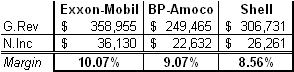
Let's pick a couple of companies more or less at random and do some "back-of-the-envelope" calculations to compare profit margins: Coca-Cola, Proctor & Gamble, & McDonalds. We'll compare them to Exxon-Mobil, BP, and Shell. All figures are in millions of dollars and all are from the companies 2005 10k filings (G.Rev is Gross Revenue & N.Inc is Net Income).
First let's look at the oil companies:
Now let's compare these profit margins with those of the other companies:
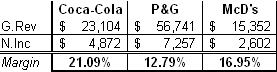
If oil companies are "gouging us" for their 8-10% profits, what does that say about these companies? Where's the outrage, I ask?
In reality, of course, there's no "gouging" at all, merely the law of supply and demand in operation. But why on earth should we let facts get in the way of public opinion?
On the Today show this morning, Matt Lauer was interviewing Rex Tillerson, the Chairman & CEO of Exxon-Mobil. Of course the issue of increasing gas prices was the main topic. In a response to a question on whether or not the gas companies were going to give consumers "a break", Tillerson responded that the primary goal of Exxon-Mobil was to return value to its shareholders. He said quite explicitly: "to make money".
I actually found myself applauding. Especially after I listened to an NPR call-in show last night with caller after caller demanding that the government seize the oil company's "excess profit" and use it to fund public transportation or refund it to consumers.
I found Mr. Tillerson's statement of fact to be refreshing, but is it really the case that anyone needed to say it? Isn't it something we should already know? Is economics not even an elective at high schools and colleges anymore? Is it really the case that the average American (and no, I don't mean the average Jerry-Springer-watcher) doesn't understand supply and demand? Doesn't understand basic Capitalism 101? Or is it just the usual, lazy, "I don't care what's going on unless it touches me. Then, I don't care who I hurt, what laws I have to break, or what principles I must violate in order to get rid of it."
I, for one, am dead-dog tired of hearing citizens and politicians alike whine about high gas prices and blame it on gasoline companies. According to various sources, oil company profit margins tend to be around 7-10%. And they haven't changed much if at all through this latest "crisis". The fact is that oil companies earn a lot less profit (as a percentage of total revenue) than a great many other American businesses and yet we don't accuse other businesses of gouging and try to organize government-sponsored theft of their earnings.
Let's pick a couple of companies more or less at random and do some "back-of-the-envelope" calculations to compare profit margins: Coca-Cola, Proctor & Gamble, & McDonalds. We'll compare them to Exxon-Mobil, BP, and Shell. All figures are in millions of dollars and all are from the companies 2005 10k filings (G.Rev is Gross Revenue & N.Inc is Net Income).
First let's look at the oil companies:

Now let's compare these profit margins with those of the other companies:

If oil companies are "gouging us" for their 8-10% profits, what does that say about these companies? Where's the outrage, I ask?
In reality, of course, there's no "gouging" at all, merely the law of supply and demand in operation. But why on earth should we let facts get in the way of public opinion?
01 May, 2006
The ABC meme...
Okay, so another lengthy absence. Broken today, however, by my personal continuation of a meme circulating in the blogsphere (hat tip to Good Math, Bad Math).
Accent: Southern, but not "too" Southern...
Booze: Is wine considered booze? If so, I'll say wine. Mostly Bordeaux, Riesling, or sweet dessert wines (like Eiswein (ah, Botrytis!) or Sauternes). If not, then Gin (Hendricks) and Vodka (Grey Goose or Ciroc)
Chore I hate: All of them, but mostly yardwork.
Dog or Cat: Dog. We have two, both poodles, one a toy white and the other a miniature red.
Essential Electronics: Palm, iPod, Cell Phone. I know they haven't always been around, but I especially don't know what I'd do without the latter.
Favorite Cologne: Crabtree & Evelyn's Essence of Mysore Sandalwood & L'Occitane's Eau de Quatre Voleurs.
Gold or Silver: Gold, although not in the "blingy" sense...
Hometown: Born in Atlanta, GA. Raised in Lynchburg, VA.
Insomnia: Occasionally; especially when either my wife or I travel and I'm forced to sleep alone.
Job title: Sr. Business Analyst. That's "corporate speak" for "general flunky who has a lot of diverse yet useful skills and upon whom we can depend to get stuff done that none of our more highly paid "experts" know how to do"
Kids: None.
Living arragements: House in Summerfield, NC.
Most admirable traits: Hmmm..."truthiness"...
Not going to cop to: Yeah, right...nice try.
Overnight hospital stays: The usual stuff as a kid, I suppose (tonsils). As an adult, only an appendectomy. I suppose I've been quite lucky in that respect.
Phobias: Heights. Big time.
Quote: "When in danger, fear, or doubt, run in circles, scream and shout" -- Robert Heinlein.
Religion: None. I'm a Humanist.
Siblings: Two brothers and two sisters, all younger.
Time I wake up: During the week, around 0630. On the weekends, usually before 0900.
Unusual talent or skill: Hmmm..."unusual"...well, I can tie a cherry stem into a knot with my tongue. Is that unusual enough? Well, freakishness aside, I have a gift for mimicry and can pick up foreign languages and accents rather quickly.
Vegetable I love: Although I like most vegetables, my favorite is probably Broccoli. There should also be a "vegetable I hate" category, but since there's not, I'll add mine here: Okra. Disgusting.
Worst habit: I'll take procrastination as well. The meager number of posts to my blog should be evidence enough...
X-rays: Most recently, of my back to determine whether or not I actually had a ruptured disc (I do).
Yummy foods I make: I'm a pretty good cook. I make a mean marinara sauce that we usually bottle and give away as Xmas gifts. I also make pretty good chili.
Zodiac sign: I think astrology is complete and utter bollocks.
Oh, and I'm a Virgo.
02 March, 2006
Is Rationalism Winning?
It seems like every day we hear about yet another religiously motivated assault on science education via attempts to insert mythology or pseudo-science into biology classes. Despite general success to date in quashing such nonsense, with what appears to be an increasing amount of activity on this front supporters of science may begin to despair of ever really winning this battle.
However, despite appearances to the contrary, there may yet be reason to hope. In the context of a discussion about an encounter with a particular creationist, a commenter at A Somewhat Old, But Capacious Handbag notes that the current shift from creationism to "intelligent design" may well signal a recognition from the opponents of rationalism that they have lost the battle on its traditional metaphysical field. By attempting to don the mantle of science, they are acknowledging that their previous attempts to hijack faith as a tool to force their narrow anti-reason ideology on science education have failed miserably. I can't say it better than the commenter, so I'll just quote:
However, despite appearances to the contrary, there may yet be reason to hope. In the context of a discussion about an encounter with a particular creationist, a commenter at A Somewhat Old, But Capacious Handbag notes that the current shift from creationism to "intelligent design" may well signal a recognition from the opponents of rationalism that they have lost the battle on its traditional metaphysical field. By attempting to don the mantle of science, they are acknowledging that their previous attempts to hijack faith as a tool to force their narrow anti-reason ideology on science education have failed miserably. I can't say it better than the commenter, so I'll just quote:
In the past, the biblical literalist was content to argue from a spiritual ivory tower, throwing out the same old arguments from authority and tradition that you see here, but from a foundation of assumed superiority. Their status as theologians raised them above mere scientists like yourself, in their own eyes and, more significantly, in the eyes of the rest of the world.Whether he's correct or not certainly remains to be seen, but it may indeed be reason for a tad more optimism.
That the Soapy Sams of the 21st century have to pass their tribal myths off as scientific theory is an indicator of how well rationalists are doing. Their framing of creationism as science is a tacit admission that they cannot fight this battle on their home turf anymore, because people frequently listen to scientists more than theologians.
All the arguments remain the same tiresome fallacies, and scientists are more than equal to shooting them down; the only difference is you're playing at home now, and as the Dover trial showed, you stand a very good chance.
Chin up! You can't win the war overnight, but I think you might have won a few battles you weren't even aware you were fighting.
01 March, 2006
Voices of Reason
Via Andrew Sullivan, a link to Jyllands-Posten and their publication of an anti-Islamist manifesto, "Together facing the new totalitarianism":
The signatories are notable intellectuals & writers, many of whom are members of the religious and ethinic Muslim community. People like Ayaan Hirsi Ali, Taslima Nasreen, Salman Rushdie, & Ibn Warraq. The sad fact is that while such statements are needed now more than ever before, they will likely fall on ears deafened by the hate-filled cries of fanatics and fail to be acknowledged by minds destroyed by dogmatic, fundamentalist ideology.
The recent events, which occurred after the publication of drawings of Muhammed in European newspapers, have revealed the necessity of the struggle for these universal values. This struggle will not be won by arms, but in the ideological field. It is not a clash of civilisations nor an antagonism of West and East that we are witnessing, but a global struggle that confronts democrats and theocrats.Heroic sentiments, indeed. Doubly so perhaps when one remembers that Jyllands-Posten is the same newpaper that originally published the now infamous drawings.
Like all totalitarianisms, Islamism is nurtured by fears and frustrations. The hate preachers bet on these feelings in order to form battalions destined to impose a liberticidal and unegalitarian world. But we clearly and firmly state: nothing, not even despair, justifies the choice of obscurantism, totalitarianism and hatred. Islamism is a reactionary ideology which kills equality, freedom and secularism wherever it is present. Its success can only lead to a world of domination: man's domination of woman, the Islamists' domination of all the others. To counter this, we must assure universal rights to oppressed or discriminated people.
The signatories are notable intellectuals & writers, many of whom are members of the religious and ethinic Muslim community. People like Ayaan Hirsi Ali, Taslima Nasreen, Salman Rushdie, & Ibn Warraq. The sad fact is that while such statements are needed now more than ever before, they will likely fall on ears deafened by the hate-filled cries of fanatics and fail to be acknowledged by minds destroyed by dogmatic, fundamentalist ideology.
Long Absence
Wow. What a busy end-and-beginning-of-year period I've had. I've taken on a host of new responsibilities at work as well as the necessity of a fair amount of travel over the last couple of months. Result: no blog entries. Hopefully that's coming to an end and I'll be able to resume my prolific one/two-post-per-week rate I was maintaining previously.
10 January, 2006
Would you have been a Nazi?
A friend pointed me to the "Would you have been a Nazi?" quiz on the OKCupid website. The results weren't exactly what I expected, and I reflected on what this might mean either about the quiz or myself...
Here are the results I obtained:
Here are the results I obtained:
The Expatriate
Achtung! You are 38% brainwashworthy, 31% antitolerant, and 33% blindly patrioticCongratulations! You are not susceptible to brainwashing, your values and cares extend beyond the borders of your own country, and your Blind Patriotism does not reach unhealthy levels. If you had been German in the 30s, you would've left the country.
One bad scenario -- as I hypothetically project you back in time -- is that you just wouldn't have cared one way or the other about Nazism. Maybe politics don't interest you enough. But the fact that you took this test means they probably do. I'm gonna give you the benefit of the doubt.
Did you know that many of the smartest Germans departed prior to the beginning of World War II, because they knew some evil shit was brewing? Brain Drain. Many of them were scientists. It is very possible you could have been one of them.
Conclusion: born and raised in Germany in the early 1930's, you would not have been a Nazi.
It could have been worse; other possible results were "The Foot Soldier", "The Everyday German", "Der Kommandant", even "Adolf Hitler"! On the other hand, I might have also gotten "The Resistance" had I answered the questions in such a manner as to indicate that I would have fought the Nazi regime rather than simply emigrated. I, like many others I'm sure, would like to think that I would have done so in such a situation.
Of course, there's certainly a likelihood that the quiz design doesn't correspond exactly with how I might myself interpret or respond to the questions, and I certainly don't give ultimate credence to an internet quiz. However, in light of the fact that my worldview demands a strong response to moral evil, such a "non-committal" outcome gives me opportunity to pose a question with which I often struggle: faced with the reality of such a sitution, would I actually find the courage to live up to the principles I value so highly and which I believe myself to have?
As a high school student, I remember seeing the movie The Hiding Place, a dramatization of the true story of a Dutch family that hid Jews from the Nazis during WWII. Like many others, I also read The Diary of Anne Frank. Many years later, I can still feel the impact such stories had on the development of my moral sense. I do hope that, faced with such implacable and overt evil, I would respond as I believe myself obligated, but even so, I am forced to admit that we often do not know how we will respond to any given situation until we are in fact faced with it.16 December, 2005
Libertarian Credentials?
Results from a Quizilla quiz:
Libertarian - You believe that the main use for
government is for some people to lord it over
others at their expense. You maintain that the
government should be as small as possible, and
that civil liberties, "victimless
crimes", and gun ownership should be basic
rights. You probably are OK with capitalism.
Your historical role model is Thomas Jefferson.
From
Which political sterotype are you?
brought to you by Quizilla
Although the questions are quite broad and lend themselves easily to misinterpretation, the quiz is amusing and won't take long.08 November, 2005
Humor...ha, ha.
Over at Hit and Run (Reason magazine's blog), a humorous take on Benjamin Franklin's famous bon mot: "Beer is proof that God loves us and wants us to be happy."04 November, 2005
A basic problem with "originalism"
I love Positive Liberty. It's one of those rare blogs that I can always depend on to be interesting and informative.
Jason Sandefur posts an article today wherein he examines a critical assumption underlying much of the "originalist" concern about "activist judges". To whit, that words have absolute meanings that don't or can't change over time. Although this may sound ridiculous on it's face, there's simply no other way to parse their objections in light of the context of reality.
Sandefur forms his critique by examining remarks made by one of our most prominent, if not the most prominent, originalists: Antonin Scalia. Specifically, a review of a popular legal work that Scalia wrote for the conservative Catholic journal First Things (an excellent if often infuriating publication). In his article, Jason lays out the basic metaphysical error being committed by Scalia and others like him. It's well worth the read.Don Colxote, the Lord of PFMancha
Writing in the Prison Fellowship newsletter, BreakPoint, Charles Colson (former Nixon administration felon turned born-again Christian) attempts to enlist the aid of the HH Tenzin Gyatso, the 14th Dalai Lama in his quest to confound the evils of "scientific materialism" (Fundamentalist code-speak for "evolution"). Unfortunately for him, while the Dalai Lama may indeed be a fellow spiritualist, Colson's attempt to twist his words to align with his own goals falls far short of the mark.
Colson begins by noting that the Dalai Lama, writing in his most recent book The Universe In A Single Atom, rejects the metaphysical stance known as materialism. For Colson, this indicates some degree of consonance with his own, Christian, views. So far as it goes, this is true enough if unsurprising.
However, from this single point of similarity he goes on to make the following simply staggering non sequitur:If this sounds familiar, it ought to: These are the very arguments that we have made here at “BreakPoint” and that other proponents of intelligent design make. In view of the profound differences between Tibetan Buddhism and Christianity, it simply isn’t credible to dismiss intelligent design as simply “a repackaging of [Christian] creationism.”The logical implication of this statement is that a rejection of materialism equals an acceptance of ID. Aside from the fact that neo-Darwinism does not depend upon a materialist metaphysic, the fact that many Christians (non-materialists by definition) accept evoluion absolutely falsifies Colson's abortive argument. What's worse for Colson in this instance is that the Buddhist doctrine of "dependent origination" explicitly rules out any first cause and the Buddhist teachings on causality rule out any intelligent direction on the course of the development of life. We are left with the reality that although Buddhists share the Christian denial of materialism, they cannot be supporters of ID.
So what does the Dalai Lama have to say about evolution in his book? Well, nothing specific that I can find, however he does have the following to say about science:My confidence in venturing into science lies in my basic belief that as in science so in Buddhism, understanding the nature of reality is pursued by means of critical investigation: if scientific analysis were conclusively to demonstrate certain claims in Buddhism to be false, then we must accept the findings of science and abandon those claims.In this he's certainly different from the main class of creationists, Colson no doubt included.Buddhism must accept the facts — whether found by science or found by contemplative insights. If, when we investigate something, we find there is reason and proof for it, we must acknowledge that as reality — even if it is in contradiction with a literal scriptural explanation that has held sway for many centuries or with a deeply held opinion or view.Again, no creationism here, and a very high opinion of science.As my comprehension of science has grown, it has gradually become evident to me that, insofar as understanding the physical world is concerned, there are many areas of traditional Buddhist thought where our explanations and theories are rudimentary when compared with those of modern science.Well, it doesn't seem like much of a leap to posit that the Dalai Lama very likely has no problem with evolution, contrary to Colson's attempt to paint him as a fellow traveler.
Clearly Colson is way off the mark in using the Dalai Lama as an example to attempt to demonstrate that ID isn't just a "repackaging of Christian creationism". In reality, of course, ID is just that.
Colson closes his article by portraying the pro-evo crowd as academic bullies, attempting to silence scientific dissent:It is the close-minded academics who are being dogmatic, foreclosing scientific inquiry. They call even the merest mention of scientific evidence suggesting that life couldn’t have arisen as a result of an unplanned, random process as “religion,” and they throw it out.There are a few problems with this:
1) The biological theory of evolution has nothing to do with how life arose, but how current forms have arisen from a common ancestor.
2) Evolution isn't random; this is a common creationist error. Mutations are random, but natural selection is anything but.
3) There simply is no credible scientific evidence that calls the neo-Darwinian paradigm into serious question. This "evidence" to which Colson refers is based on religious belief and speculation arising from that belief. Anyone who doubts this has merely to look at the amount of real scientific research being done into ID: none. Contrast that with the vast amounts of PR and political sleight-of-hand being employed and the reality becomes quite clear: ID is nothing but our old friend, creationism, in some spiffy new clothes.30 September, 2005
Where's the outrage?!?
Jason Kuznicki of Positive Liberty has an excellent, must-read article on the travesty of justice that is the current administration's treatment of Jose Padilla. Anyone interested in the state of liberty in "the home of the free" would do well to take heed.Bookworms of the World, Unite!
From Majikthise via Pharyngula comes the notion of the "Most Challenged Books Meme". How many of the American Library Association's 100 most-frequently-challenged books have you read? (Mine in Bold)
1. Scary Stories (Series) by Alvin Schwartz
2. Daddy’s Roommate by Michael Willhoite
3. I Know Why the Caged Bird Sings by Maya Angelou
4. The Chocolate War by Robert Cormier
5. The Adventures of Huckleberry Finn by Mark Twain
6. Of Mice and Men by John Steinbeck
7. Harry Potter (Series) by J.K. Rowling
8. Forever by Judy Blume
9. Bridge to Terabithia by Katherine Paterson
10. Alice (Series) by Phyllis Reynolds Naylor
11. Heather Has Two Mommies by Leslea Newman
12. My Brother Sam is Dead by James Lincoln Collier and Christopher Collier
13. The Catcher in the Rye by J.D. Salinger
14. The Giver by Lois Lowry
15. It’s Perfectly Normal by Robie Harris
16. Goosebumps (Series) by R.L. Stine
17. A Day No Pigs Would Die by Robert Newton Peck
18. The Color Purple by Alice Walker
19. Sex by Madonna
20. Earth’s Children (Series) by Jean M. Auel
21. The Great Gilly Hopkins by Katherine Paterson
22. A Wrinkle in Time by Madeleine L’Engle
23. Go Ask Alice by Anonymous
24. Fallen Angels by Walter Dean Myers
25. In the Night Kitchen by Maurice Sendak
26. The Stupids (Series) by Harry Allard
27. The Witches by Roald Dahl
28. The New Joy of Gay Sex by Charles Silverstein
29. Anastasia Krupnik (Series) by Lois Lowry
30. The Goats by Brock Cole
31. Kaffir Boy by Mark Mathabane
32. Blubber by Judy Blume
33. Killing Mr. Griffin by Lois Duncan
34. Halloween ABC by Eve Merriam
35. We All Fall Down by Robert Cormier
36. Final Exit by Derek Humphry
37. The Handmaid’s Tale by Margaret Atwood
38. Julie of the Wolves by Jean Craighead George
39. The Bluest Eye by Toni Morrison
40. What’s Happening to my Body? Book for Girls: A Growing-Up Guide for Parents & Daughters by Lynda Madaras
41. To Kill a Mockingbird by Harper Lee
42. Beloved by Toni Morrison
43. The Outsiders by S.E. Hinton
44. The Pigman by Paul Zindel
45. Bumps in the Night by Harry Allard
46. Deenie by Judy Blume
47. Flowers for Algernon by Daniel Keyes
48. Annie on my Mind by Nancy Garden
49. The Boy Who Lost His Face by Louis Sachar
50. Cross Your Fingers, Spit in Your Hat by Alvin Schwartz
51. A Light in the Attic by Shel Silverstein
52. Brave New World by Aldous Huxley
53. Sleeping Beauty Trilogy by A.N. Roquelaure (Anne Rice)
54. Asking About Sex and Growing Up by Joanna Cole
55. Cujo by Stephen King
56. James and the Giant Peach by Roald Dahl
57. The Anarchist Cookbook by William Powell
58. Boys and Sex by Wardell Pomeroy
59. Ordinary People by Judith Guest
60. American Psycho by Bret Easton Ellis
61. What’s Happening to my Body? Book for Boys: A Growing-Up Guide for Parents & Sons by Lynda Madaras
62. Are You There, God? It’s Me, Margaret by Judy Blume
63. Crazy Lady by Jane Conly
64. Athletic Shorts by Chris Crutcher
65. Fade by Robert Cormier
66. Guess What? by Mem Fox
67. The House of Spirits by Isabel Allende
68. The Face on the Milk Carton by Caroline Cooney
69. Slaughterhouse-Five by Kurt Vonnegut
70. Lord of the Flies by William Golding
71. Native Son by Richard Wright
72. Women on Top: How Real Life Has Changed Women’s Fantasies by Nancy Friday
73. Curses, Hexes and Spells by Daniel Cohen
74. Jack by A.M. Homes
75. Bless Me, Ultima by Rudolfo A. Anaya
76. Where Did I Come From? by Peter Mayle
77. Carrie by Stephen King
78. Tiger Eyes by Judy Blume
79. On My Honor by Marion Dane Bauer
80. Arizona Kid by Ron Koertge
81. Family Secrets by Norma Klein
82. Mommy Laid An Egg by Babette Cole
83. The Dead Zone by Stephen King
84. The Adventures of Tom Sawyer by Mark Twain
85. Song of Solomon by Toni Morrison
86. Always Running by Luis Rodriguez
87. Private Parts by Howard Stern
88. Where’s Waldo? by Martin Hanford
89. Summer of My German Soldier by Bette Greene
90. Little Black Sambo by Helen Bannerman
91. Pillars of the Earth by Ken Follett
92. Running Loose by Chris Crutcher
93. Sex Education by Jenny Davis
94. The Drowning of Stephen Jones by Bette Greene
95. Girls and Sex by Wardell Pomeroy
96. How to Eat Fried Worms by Thomas Rockwell
97. View from the Cherry Tree by Willo Davis Roberts
98. The Headless Cupid by Zilpha Keatley Snyder
99. The Terrorist by Caroline Cooney
100. Jump Ship to Freedom by James Lincoln Collier and Christopher Collier
That's 24 by my count. I used to think I was well-read...Subscribe to: Posts (Atom)About Me

View my complete profile
- Bill Snedden
- I was born and am still alive, residing in the great state of North Carolina. I sustain my body through gainful employment and my mind through reading and writing. Motto: Omnia Mutantur, Nihil Interit -- Ovid
Subscribe To This Blog

Posts





