01 December, 2006

Oh dear...

I guess I'd better turn myself in...

Your 'Do You Want the Terrorists to Win' Score: 94%

You are a terrorist-loving, Bush-bashing, "blame America first"-crowd traitor. You are in league with evil-doers who hate our freedoms. By all counts you are a liberal, and as such cleary desire the terrorists to succeed and impose their harsh theocratic restrictions on us all. You are fit to be hung for treason! Luckily George Bush is tapping your internet connection and is now aware of your thought-crime. Have a nice day.... in Guantanamo!

Do You Want the Terrorists to Win?
Quiz Created on GoToQuiz


HT: Radley Balko

29 November, 2006

Xmas concerts!

I just realized that the season is upon us and yet I've not had a post detailing upcoming Xmas concerts for either of the two groups with which I perform.

The Bel Canto Co. will give its annual Xmas concerts on Dec. 1, 2, & 4 at Christ United Methodist church in Greensboro, NC. All programs begin at 7:30 pm. More information is available here.

The Kensington Consort will give its Xmas concert on Dec. 22nd at St. Andrews Episcopal church in Greensboro, NC. This program will begin at 7:00 pm. More information is available here.

If you're in the Greensboro, NC area, please do attend one or both of these concerts. The Bel Canto Xmas concert is an area tradition and is the perfect way to start the holiday season while the Kensington Consort concert will be a refreshing tonic after weeks of frenetic holiday shopping!

28 November, 2006

The King of Woo-Woo

At HuffPo, Deepak Chopra continues his feckless attempt to fisk Richard Dawkins' latest book The God Delusion. PZ takes this one to task pretty well, but I want to take this opportunity to single out something Chopra said for special treatment.

Chopra offers this argument which he apparently considers to "close the case" against materialism:

Think of a yellow flower. Can you see it? Are you sure of the color and the fact that it's a flower and not a fish that you can see? If so, then the experiment has been successful. You have made a major strike at the root of materialism. When you see a flower in your mind, there is no flower inside your brain. That seems simple enough. But where is the flower? There's no picture of it in your cerebrum, because your brain contains no light. How about the color yellow? Is there a patch of yellow inside your brain's gray matter? Obviously not.

Did you miss it? The argument against materialism, that is. Just in case, here are the bare bones of Chopra's reductio (including the hidden premises):

  1. According to materialism, the nature of consciousness is physical
  2. Assume materialism is true (arguendo)
  3. For a materialist consciousness to imagine an existent, there must be a physical representation of that existent in the brain.
  4. There are no yellow flowers or images of yellow flowers to be found in the brain, neither is any part of the brain "yellow" or "flowery"
  5. Therefore, people cannot imagine yellow flowers
  6. But people can and do imagine yellow flowers
  7. Therefore, materialism is false
I'll have more to say about this later. Anyway, Chopra goes on to say:

Yet you assume--as do all who fall for the superstition of materialism--that flowers and the color yellow exist 'out there' in the world and are photographically reproduced by the brain, acting as a camera made of organic tissue. In fact, existence of flowers shifts mysteriously once it is closely examined. The experience of sight, sound, touch, taste, and smell is created in consciousness. Molecules don't assemble in your head to make the sound of a trumpet blaring in a brass band, for example. The brain is silent. So where does the world of sights and sounds come from?

Materialists cannot offer any reasonable explanation. The fact is that an enormous gap exists between any physical, measurable event and our perception. If I talk to you, all I am doing is vibrating air with my vocal cords. Every aspect of that event can be seen and measured, but turning those vibrating air molecules into meaningful words has never been seen or measured. It can't be.

Well, to begin with, this isn't completely correct. The connection between external stimuli and brain events HAS been seen and measured. Neurophysiologists have located specific regions of the brain that react to particular types of perceptual stimulation (sights, sounds, smells) and used MRI scanning to record images of the brain reacting to those stimuli. They've also been able to map particular regions of the brain that respond to memory recall of those stimuli (so, for example, they can show what parts of the brain respond when a subject is recalling a particular experience).

That aside, there is no doubt that consciousness does represent a "hard problem" in the philosophy of mind. However, it's no more a problem for the materialist than it is for the immaterialist for there are numerous unanswered questions on both sides.

Let's return to Chopra's "anti-materialist" argument for a moment. What can we say about the following reductio:

  1. According to non-materialism, the nature of consciousness is non-physical
  2. Assume non-materialism is true (arguendo)
  3. For a non-materialist consciousness to imagine an existent, there must be a non-physical representation of that existent in the consciousness
  4. There are no yellow flowers or images of yellow flowers to be found in the consciousness, neither is any part of the consciousness "yellow" or "flowery"
  5. Therefore, people cannot imagine yellow flowers
  6. But people can and do imagine yellow flowers
  7. Therefore non-materialism is false

It seems to me that one of Chopra's mistakes is assuming that we should be able to "see" images or pictures of the objects of consciousness by looking into the "container" of that consciousness. But why would we imagine that to be the case? Why should we expect first-person experiences to be third-person accessible, regardless of paradigm (materialism/non-materialism)? What's likely to be involved is not any actual image but a representation of an image and I see no reason to believe that images cannot have physical representations. Indeed, we have particular experience with such things in the case of digital photographs.

If I take a picture of a yellow flower, I certainly won't see any yellow flowers or pictures of yellow flowers inside my digital camera. The image is represented therein by sequences of 1's and 0's. So we can have a physical representation of a non-physical thing. And this has important implications for Chopra's original argument.

It's not clear exactly what Chopra believes would be the case given a non-material consciousness, but it would seem to be true that some theory of representation is needed (wherein objective existents are represented subjectively). Obviously Chopra believes that materialism cannot sustain such a theory, but on this his reasoning is (characteristically) opaque. However, it does seem clear that at the least, he assumes that the materialist position (all that exists is matter) is necessarily coincident with reductive physicalism (the mind is the brain). But is this true?

To begin with, materialism is not necessarily the position that "all that exists is matter". More broadly, it could be defined as the position that "all that exists is either matter or dependent upon matter for its existence." No sensible materialist would deny the existence of abstract concepts (universals), they would likely only fail to affirm their objective (external to the mind) existence. So it is necessary in our definition to accomodate this reality.

But this distinction vitiates Chopra's argument. If it is the case that the mind is non-physical, but is dependent upon the physical for its existence, then we have our materialist answer: the image of the yellow flower is "encoded" in the physical structure of the brain where it can be accessed by the consciousness and consciousness is an emergent property of the physical brain. Chopra's argument may retain force against reductive physicalists (I say "may" only because of the logical possibility; there are very likely physicalist schema that may undercut it as well c.f. Daniel Dennet).

So much for Chopra's "argument" against materialism. But what about the possibility that the mind is a non-material substance, and not dependent upon matter for its existence (as Chopra apparently believes). Does this view avoid these or other types of problems entirely? I don't think so. Where does a non-material consciousness "live"? How does it interact with the brain? Where is the evidence for its existence? Of what is it composed? How does it come into being? &c. Materialist schema can provide answers for many of these questions and for the ones where it cannot, there are usually no good answers on the non-materialist side as well.

And this is what I see as a primary difficulty with this, and actually all such (in my experience) simplistic arguments against materialist philosophies of mind. Proponents attack what they see as motes in the materialist's eye while missing the planks in their own. There are simply too many gaps in our knowledge of the brain, the mind, and the structure of existence in general to provide any definitive answers. Right now, the majority of evidence from biology, neurophysiology, & psychology appears to be on the materialist side so there is simply no reason to assume that there's any magic required. That's not to say that there are no good critiques of the materialist position in the philosophy of mind. David Chalmers and William Hasker have provided some very on-point and stimulating criticisms of the materialist and reductive physicalist positions. But Chopra and those like him who believe that blathering about flowers and pictures inside the brain represents any serious threat to materialist schema are...well...just blathering.

23 November, 2006

Irony, definition of...

Atheist "evangelist" turns tables on Mormons.

Jack Chick meets Stan Lee

We've all seen them. Those little "comic books" with religious messages that one finds abandoned in phone booths, public restrooms, and various other places. They're at times ignorant and offensive and they're the brainchild of Jack Chick, religious bigot and "artist".

While the comics can be quite (unintentionally) humorous (albeit in a rather sad, sick sort of way), there are numerous parodies available on the web that are intentionally funny and some quite so indeed. You can find some good ones here, and now a new one combining the Marvel universe created by Stan Lee and Chick's inimitable style. Enjoy!

17 November, 2006

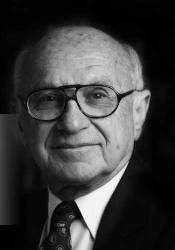
Milton Friedman, 1912-2006

Milton Friedman, Nobel Prize-winning Economist and free-market champion, died yesterday evening at age 94.

One of the great intellectuals of the twentieth century, his contributions to economics and the cause of liberty cannot be overestimated and will long be remembered. I can still remember reading Capitalism and Freedom just after college and being struck with how approachable the work was (for an economics neophyte). Friedman excelled at explaining complex ideas in relatively simple language.

His career will doubtless be celebrated at length on various economics, libertarian, and political blogs. I'll update this post with links as I locate them.

Obituaries: Financial Times, Reuters, New York Times (may require login)

Blogs: Reason magazine, Positive Liberty, Cato-at-Liberty (1,2,3,4), The Volokh Conspiracy, Andrew Sullivan, The Agitator, Jim Lippard

Other: Cato Institute, Mises Institute, Atlas Society

08 November, 2006

This just in!!

God is dead.

I guess this means Darwin really kicked his ass!

We now return you to your regularly scheduled program...

25 October, 2006

Interesting little tidbit...


HowManyOfMe.com
LogoThere are:
14
people with my name
in the U.S.A.

How many have your name?

And so on and so on...

More of Wolcott on D'Souza..

James Wolcott has another article up on Dinesh D'Souza's latest book. Ratfink Redux is Wolcott's further exposition of D'Souza's nonsense.

Wolcott's conclusion (and the money quote):

What D'Souza proposes in The Enemy at Home is that American conservatives join hands with traditional Muslims to keep gays and women subjugated and subservient. D'Souza opposes radical Islam because they want to destroy us. But Muslim restrictions on sexual freedom and strict enforcement of patriarchal diktats--those he kinda likes. Those he can work with. "What disgusts them [i.e, devout Muslims]is not free elections but the sights of hundreds of homosexuals kissing one another and taking marriage vows."

It clearly disgusts D'Souza too. Maybe he should convert.

Rather clever comeback, that. It seems indeed that D'Souza has more in common with the Islamo-"fascists" than he lets on. Who exactly is it that hates our freedom? Could it be...oh, I don't know....D'SATAN?!?

D'Souza seems to share with the Christian Right the rather bizarre opinion that gay relationships somehow "destroy the family" and will lead to the downfall of civilation. According to Wolcott he observes:
In America, sad to say, we are inured to the debris of the broken family. We accept that the traditional family is no longer the norm, it is now something like an 'alternative lifestyle.' We invite Edgar and Austin to our dinner parties.
How in the world does "invit[ing] Edgar and Austin to our dinner parties" signal that "the traditional family is no longer the norm?" What connection exists between Edgar and Austin and "the debris of the broken family?" This mantra is chanted non-stop by morons and demagogues like Pat Robertson and James Dobson but there is simply no logic which, granted the first, will lead you to the second. D'Souza has not only drunk the Kool-Aid, he's now participating in preparing it. It is ironic indeed that this screed intended to demonstrate how the cultural left is to blame for 09.11 instead demonstrates how much D'Souza and his fellow travelers share with those who truly hate America and are intent on destroying it.

On why we invite Edgar and Austin to our dinner parties, Ed Brayton observes:
Edgar and Austin are human beings, and may well be smart and funny and good conversationalists. And your alternative to this is...what? To ostracize them and shut them out? To throw them in prison? To put them to death by stoning, as the radical Muslims do? I'm sure that would make the terrorists like us more, but it would require destroying the very notion of human liberty. That is a tradeoff that is only worth making to the Bin Ladens of the world, on whose side you have firmly placed yourself with this book.
Indeed. Who is it that apparently truly hates our freedom? Self-righteous, pseudo-intellectuals like Dinesh D'Souza, that's who.

HT: Dispatches from the Culture Wars

12 October, 2006

The Sad Case of Dinesh D'Souza?

A while back, I blogged some thoughts on a "book" by neo-con pundit Jonah Goldberg. Not too much later, the vile Ann Coulter spat out her latest ("Godless") of a series of thoroughly repugnant and utterly worthless collections of drivel. I let that pass, partially because Coulter is simply beneath reply, but also partially because one tends to become inured after a time to the rantings and bleatings of wingnuts and moonbats alike and yet another spittle-flecked tome of idiotic ravings just seemed so inconsequential.

However low the pundits might themselves stoop, one doesn't, however, expect to see credentialed scholars getting in on the act, regardless of political bias. And yet today I discover that Dinesh D'Souza of the Hoover Institution will be publishing a new book with the distinctly Coulter/Ponnuru/Goldberg-ish title: The Enemy at Home: The Cultural Left and Its Responsibility for 9/11.

Huh? Wazzat? Is this the same Dinesh D'Souza who wrote "Letters to a Young Conservative?" Whose principled defenses of free market economics and classical liberalism almost made reading the National Review worthwhile? Granted, he regularly attacks "Liberal" viewpoints and I will admit that on occasion some of his post 9.11 writings have strayed close to the "Blame the Lefties!" edge (witness "10 Things to Celebrate"), but generally (it seemed to me) in the spirit of the free exchange of ideas, without vituperative accent, as one should generally expect of a scholar (as opposed to a mere talking head).

Of course, I've not seen a copy of the book (it's not scheduled for publication until January), but James Wolcott has and from his comments, it appears to be as vile a book as its title might suggest:

"I realize that this is a strong charge," D'Souza writes, "one that no one has made before."

The reason it hasn't been made before is that it's a sleazy, shameless, ignorant, ahistorical, tendentious, meretricious lie, one that was waiting for the right brazen liar to come along to promote it, and here he is, and his name is Dinesh D'Souza, who's fatuous and fuddy-duddyish enough to think that it's Britney Spears, the rap lyrics of 2 Live Crew, and the buggering photographs of the late Robert Mapplethorpe that have Islam in a tiz. This is someone so out of touch with pop culture that he thinks liberals look down on risque sitcoms like Will & Grace because "their moral depravity is not highbrow enough for their taste." Does that description fit anyone you know?

Wolcott doesn't just critique the book, he savages it. It reminds me of a Dorothy Parker review: "This is not a book to be tossed aside lightly. It should be hurled with great force."

Wolcott has much more to say, and it's worth the read. I must say I'm somewhat taken aback. While I haven't been following him regularly, I remember reading D'Souza's articles in the National Review and watching appearances on C-Span or other TV shows in the 90s and as a young libertarian/conservative found myself greatly sympathetic with many of his arguments. To see him seemingly sliding down into the same poison-pen morass as cretins like Coulter and her ilk is disappointing to say the least.

HT: Hit and Run

Update: Radley Balko agrees, and now Ed Brayton does as well.

21 September, 2006

Chavez on Bush

Lunatic spouts gibberish. World stunned. In other news, scientists find sex is cause of pregnancy. Who knew?

I'm no fan of the president, but Chavez makes him look like positively rational by example...

20 September, 2006

Fernandes-Lowder debate

Earlier this week, during my daily perusal of blogs, I saw that someone (I can't remember who at the moment) had noted that the Fernandes-Lowder debate video was now available online at the Institute of Biblical Defense website. Today, via Chris Hallquist's excellent blog I see that it's now on Google video. I was at that debate in 1999 at the Friday Center on the UNC-Chapel Hill campus and remember it pretty well. It was the only "live" debate I've attended and I found it both interesting and educational. Although I was still nominally a Christian, I had been seriously questioning my faith for a couple of years at that time and attended with the intention of truly listening to both sides. I remember being literally amazed at the rather poor arguments and rebuttal offered by Dr. Fernandes. Now that the video is freely available, I've had a chance to review it and I can see that my original assessment was really rather accurate.

It should be said that the audience was most likely not the "norm" for these types of events, which are usually hosted by Campus Crusade or some similar student ministry. This debate was the finale of a meeting of the Society of Humanist Philosophers and was co-sponsored by the Campus Freethought Association. All told, probably a little more sympathetic to Jeff Lowder's position. Still, both debaters were treated courteously and aside from a couple of obvious audience reactions during the Q&A, all arguments were given serious attention. Fernandes remarked on this himself during the Q&A. It should also be said that the video does not include all of the Q&A, although if memory serves, there's not that much lost.

At any rate, you can watch the video from the link at Jeff Lowder's website and see for yourself (oh, and if you look very hard during the first few moments of intro and later during the Q&A, you can see me on the far left hand side of the auditorium, about halfway down).

HT: The Uncredible Hallq via The Lippard Blog

14 September, 2006

Morons & Liars & Sleazebags, oh my!

It isn't enough that the Republican party has turned its back on classical liberalism, but they have to complete their moral downfall by engaging in politicking of the worst kind.

Of course, this has been going on for some time now...this is merely the latest example.

Senator Bill Frist (R - TN, the scumbag who abused his authority as a doctor when he gave an unqualified opinion on Terri Schiavo's medical condition and then later tried to downplay his unethical behavior) is not only supporting an utterly useless bill to ban internet gambling, he's attempting to append it to a defense appropriation bill in order to blackmail his fellow legislators into voting to approve it. See, it's election time and a vote against the bill will give Republicans a nice lie to use against their opponents: "See, the Democrats don't support the war on terror! They voted against this defense appropriation! Why do they hate our freedom?!"

Is this to be the legacy of conservatism? Degenerate nanny-statism and deceit?

Vote Libertarian and toss the whole bloody lot of them out on their asses!

HT: Radley Balko via Cato-at-liberty

13 September, 2006

Milton Friedman on Libertarian economics

Today must be "post a video" day, because here's another: an interview of Milton Friedman from the 60's in which he explains rather clearly and concisely exactly what's wrong with the welfare state and why a limited government is the best way to preserve liberty.


HT: Cafe Hayek

Daily Show Hilarity

What more needs to be said?


HT: Goosing the Antithesis

07 September, 2006

Moi, a Nerd?

Of course my protestation is feigned...I always knew that I was at some level of nerdiness. Now, thanks to the "Nerd Test", the exact level of my nerdiness has been quantified:

I am nerdier than 68% of all people. Are you nerdier? Click here to find out!


A "low-rank" nerd. Hmmm....in terms of social stature, is it better to be a high-ranking or low-ranking nerd?

HT: Pharyngula

17 July, 2006

Summer Reading List - #1

Well, I just returned from a relaxing week at the beach with the extended family (well, my wife's side, anyway). My usual practice at such retreats is to actually "do" as little as possible and such physical inactivity naturally creates a sort of "time vacuum" which reading tends to fill most welcomely.

I'm not generally prone to reading fiction, except science fiction and fantasy, but this summer proved to be an exception with only one of the four books I read coming anywhere close to the science fiction/fantasy genre:

The Last Witchfinder by James Morrow. Morrow's books tend to have a philosophic undertext that he illustrates through the telling of his stories. For example, his "Jehovah trilogy" (Towing Jehovah, Blameless in Abbaddon, & The Eternal Footman) sets a story of the death of God and the disposition of his two-mile-long corpse against a backdrop consisting of the Problem of Evil, the foundation of morality, and the meaning of life. I highly recommend them as thoughtful and engaging explorations of this philosophic topic and just as highly recommend this, his latest work.

Here's the basic plot (from School Library Journal by way of Amazon): England in the late 17th century is an exciting–if dangerous–home for Jennet Stearne, a teen whose family is a microcosm of the country's philosophical and religious conflicts. Though she is enthralled by Isaac Newton's theories and her progressive Aunt Isobel's scientific experiments, she also takes pride in her father, Walter, who is a highly regarded professional witch-hunter. Jennet's filial piety and belief system are overturned abruptly when blameless Isobel is burned at the stake because Walter labels her a witch. The girl vows to prevent other unjust executions by using science to prove witchcraft nonexistent. Her stubborn quest goes on for decades, leading her into wild adventures that include being captured by pirates, becoming an adoptive Native American, witnessing the Salem witch craze, and carrying on an affair with the young Ben Franklin. Jennet and her companions dash through an energetic narrative that re-creates the period believably, thanks to the author's admirable linguistic and historical research. While the protagonist is an appealing character, the real star is Newton's Principia Mathematica, whose amusing commentary provides a new twist to notions about the power and endurance of the printed word.

Yes, it really is as interesting as it sounds and Morrow's ability to weave history and fantasy together in his engaging narrative style makes this book a real pleasure to read as well.

26 May, 2006

Some thoughts on Euthyphro

Plato's Euthyphro is truly one of the great classics of philosophy. In this post I want to offer some general thoughts on its central argument as a prelude to a later post exploring a particular epistemological concern and its relationship to Euthyphro's dilemma.

In the dialogue Socrates and Euthyphro discuss the nature of holiness, arriving finally at the well-known ( among philosophers and students of philosophy, anyway!) dilemma:
  • Are things holy because they are loved by the gods?
  • Or are things loved by the gods because they are holy?
Euthyphro wavers between one and the other while Socrates ruthlessly eviscerates every argument he poses. One the one hand, holiness depends upon arbitrary whim while on the other, the gods themselves appear redundant to the question of holiness. Neither option seems wholly satisfactory and yet Euthyphro is unable to see where the fault lies.

Although Socrates and Euthyphro are discussing "holiness", the dilemma is extendable to other concepts, most commonly that of good:
  • Is "good" that which is commanded by God?
  • Or are things commanded by God because they are good?
In the realm of moral philosophy, Euthyphro's dilemma is employed most commonly against arguments for so-called "Divine Command"(DC) morality, which hold that "good" either stems from or is known by God's commands. However, the tactic really only works against the idea of Divine Command simpliciter. That is, the idea that "good" is constituted by God's commands. But this would seem to be a rather naive version of this theory and one not often encountered by knowledgeable theists who will more often assert that "good" is in fact a reflection of God's nature and not the arbitrary result of His commands. For the more sophisticated theist intent on arguing a version of DC theory, this notion can be accompanied by a further assertion that God's commands are a reflection of His nature and thus form the epistemic ground of "good" (how we know what "good" is).

But rather than solving the dilemma, this sort of brings us right back to it. Even in this more sophisticated version of DC, there would seem to be no epistemic difference between "God commands that which is good, based on his nature" and "God's commands are good." This is so because we have no independent means of verifying that God's commands reflect something external to His will (His nature) and thus, epistemically speaking, both versions are really equivalent.

There are certainly other means of grounding morality in God's nature, but the theist intent on paring this grounding with the certification of God's alleged commands as "good" regardless of any external verification would seem to have to deal with Euthyphro's dilemma.