05 July, 2007

Beverly Sills, 1929-2007

The irrepressible diva succumbed to lung cancer on Monday, July 2d. If memory serves, I first heard her on a Met radio broadcast in the early 80's and subsequently listened to many, many of her recordings over the years. Although in later years her voice began to show some strain from constant performance, her earlier performances were magnificent (I have the original cast recording of Moore's "Ballad of Baby Doe" and it is simply delightful). It was not without cause that she is credited with bringing American opera singers to the notice of both European and American opera companies, opening doors for young American-trained singers in what had previously been an arena dominated by Europeans. Her leadership at the New York City Opera was instrumental in rescuing a company in distress and turning it into a viable business. In addition to her arts and business acumen, she was apparently a truly generous and vital person. Her first autobiography, "Bubbles: a Self-Portrait", is an enjoyable read, rich with anecdotes and charming insight into the trials, tribulations, and joys of both a professional singer and real human being. She is survived by two children (by her first husband), three stepchildren (of her second husband, Peter Greenough, who died last year), a brother, and the enduring legacy of her contribution to the world of opera and the arts.

New York Times Obituary (from which the image accompanying this post is taken)

10 June, 2007

07 June, 2007

Infinite image?

Okay, this is super cool. It's a flash animation, so the image here is only one frame of it, but the entire animation has the appearance of infinite recursivity. That is to say that each of the images appears to contain other images that contain other images that in turn eventually contain the original image. You click on the animation and then move your mouse up to move forward and down to move backward (in the perspective of the image). Doing so you appear to move deeper into or out of the image itself. It's like drilling down into a huge and very deep well of images, all connected.

I can imagine how the images are linked together (frames that are designed to look like one is fading into another), but is the appearance of each frame truly random (as it appears to be) or is there some kind of symmetry at work? At any rate, really very imaginative and cool...

Funny O' The Day


From SomethingAwful's Photoshop Phriday offering: "Children's Books".

06 June, 2007

Death by soundbite...

Al Gore's latest book, The Assault on Reason, purports to detail how (in the words of the description at Amazon.com) "...the politics of fear, secrecy, cronyism, and blind faith has combined with the degradation of the public sphere to create an environment dangerously hostile to reason." I haven't yet read the book, but it's on my list. Even so, I find myself in immediate agreement with his thesis. Simply put, it fits perfectly with my own experiences and observations over the last decade or so. Interestingly enough, this observation also dovetails neatly with a story I just read about Ray Bradbury's Fahrenheit 451, but I'll save that for a following post...

Oh, and the illustration is the 05.28.07 Tom the Dancing Bug by Ruben Bolling. On point as usual and found at gocomics...

29 May, 2007

Funny O' The Day

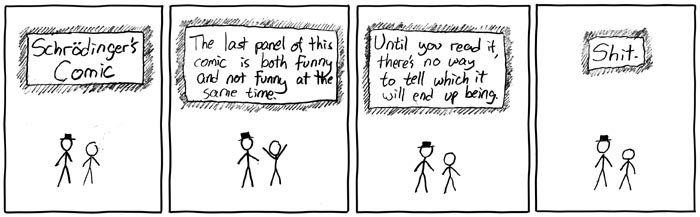
From "xkcd"

Latest blog meme...


You scored as Scientific Atheist, These guys rule. I'm not one of them myself, although I play one online. They know the rules of debate, the Laws of Thermodynamics, and can explain evolution in fifty words or less. More concerned with how things ARE than how they should be, these are the people who will bring us into the future.

Scientific Atheist


92%

Spiritual Atheist


83%

Agnostic


58%

Theist


25%

Militant Atheist


25%

Apathetic Atheist


25%

Angry Atheist


8%

What kind of atheist are you?
created with QuizFarm.com


HT: De Rerum Natura

21 May, 2007

The Way I See It

If you've bought a cup of Starbucks coffee lately, you've likely noticed that many, if not all, of the cups have these nifty quotes printed on them. The quotes are part of a marketing campaign to "spark conversation", or as Starbucks puts it,
In the tradition of coffee houses everywhere, Starbucks has always supported a good, healthy discussion. To get people talking, “The Way I See It” is a collection of thoughts, opinions and expressions provided by notable figures that now appear on our widely shared cups.
As you may also have seen in various news stories, Starbucks has caught a little amount of flak for this program due to the allegedly large percentage of the quotes which are claimed by detractors to be either "liberal" or of the "freethinking" variety. (for example, Worldnutdaily had an article a month or so ago about a Catholic woman "offended" by a humanistic quote).

Now, I've been a regular (almost daily) Starbucks customer for years. I've seen many of these quotes and in reality there's no bias present in the quotes whatsoever. For every "atheist" or "freethinking" quote, there's a Deepak Chopra or Rick Warren to offset it. For every "liberal" there's a Jonah Goldberg. In this case, the whiners are just more of the same fragile individuals whose worldviews simply can't stand up to opposing opinions. Unfortunately for them, everyone's entitled to his/her own opinion, and with so many people out there, it's likely that you won't have to look very far to find someone with whose opinion about something you're likely to disagree.

For myself, I kind of like the quotes. They're almost always thought-provoking and interesting and other people's opinions are just that: opinions. Offensive some might be, but that's just the way things are bound to be.

But what about when someone's "opinion" is obviously and egregiously false? And what about situations in which such a falsehood approaches the moral equivalent of libel?

At Civil Commotion, Robert Felton calls our attention to a quote he found on a Starbucks coffee cup:
Darwinism’s impact on traditional social values has not been as benign as its advocates would like us to believe. Despite the efforts of its modern defenders to distance themselves from its baleful social consequences, Darwinism’s connection with eugenics, abortion and racism is a matter of historical record. And the record is not pretty.
Via Starbuck's website, I see that the quote (The Way I See It #224) is from Jonathan Well's book, The Politically Incorrect Guide to Darwinism and Intelligent Design. Wells is a well-known evolution denier and the author of Icons of Evolution, one of the first of the modern attempts to use the trappings of science (without any of the actual methodology or content) in an effort to cast doubt on evolutionary theory.

But Well's statement doesn't just represent an opinion. His statement is obviously and egregiously false. Darwinism has NO connections to eugenics, abortion, or racism. None. These oft-repeated falsehoods have been debunked many, many times by many people. That Wells repeats them is an indicator of the level to which he's willing to sink in order to further his agenda.

I can certainly understand Starbucks wanting to provide an open forum for opinions and the exchange of ideas, but since when should that include countenancing the promulgation of obvious and egregious falsehoods? If Wells were a holocaust denier or a geocentrist, would his "opinion" still have been printed? Surely the mere fact that this is his opinion shouldn't shield it from editorial review? Doesn't Starbucks have a responsibility NOT to promote obvious falsehoods?

Even further, doesn't Starbucks have a responsibility NOT to disseminate material of a libelous nature? If Wells' statements were to be true, surely it would cast evolutionary biologists and other proponents of Darwin's theory as moral reprobates. Only a degenerate would participate in teaching and promoting an idea with such truly negative consequences. And truth would be a positive defense to a charge of libel, so Wells' statement would be wholly justified.

But Wells' statement is NOT true. And demonstrably so by multiple sources. And a falsehood that maligns the character of innocents for no purpose other than to further a personal agenda is quite possibly an example of libel. Now Well's libelous behavior doesn't surprise me (Google his name for plenty of examples of his disgusting tactics), but in this case, Starbucks must share the blame for turning a blind eye in the name of "diversity". And that's the way I see it...

Update: A little more searching locates posts on the Starbucks coffee cup topic at Stupid Evil Bastard, Dispatches from the Culture Wars and Atheist Jew.

Funny O' The Day

Another from xkcd:

18 May, 2007

Executive Privilege

Stephen Heersink posts some timely, lucid, and polemic thoughts on Executive Privilege as practiced by the current occupant of the Oval Office. I'm going to post some quotes and comments below, but please do read the entire original; it's well worth the time.

In discussing the history of the idea, Heersink notes:
Ever since George Washington became the nation's first president, our government's chief executive has appealed to "executive privilege." Infrequently, even hesitatingly, but under "special" circumstances and situations. Executive privilege, in this sense, is an Executive's exemption from accountability and scrutiny for reasons outside the ordinary functions of an open and free society for extraordinary reasons -- often for "national security" and/or "access to candid/privileged counsel."

But as the Watergate incident reminds us, "executive privilege" cannot be invoked to "hide" corruption, malfeasance, ineptitude, illegality, or the "people's right to know." In 1974, the Supreme Court in United States v. Nixon held: "the valid need for protection of communications between high Government officials and those who advise and assist them in the performance of their manifold duties" and that "[h]uman experience teaches that those who expect public dissemination of their remarks may well temper candor with a concern for appearances and for their own interests to the detriment of the decision-making process." But, it granted no "further reach" of Executive Privilege.
Take note of the particularly narrow construal the Court makes. Now compare that with the increasing invocations of such privilege by the White House. Heersink notes the appalling performance(s) by the current Attorney General as a example of the depths to which the administration has sunk.
In our system of government, this "absolute executive privilege" just does not stretch as far as Bush's delusional imagination. Observing the nation's Attorney General deliberately deceive Congress and the Public to "hide" the President's actions through dissimulation will necessarily persist, because Gonzales' departure would "open" an opportunity to get past the grand-standing, deceptions, and dissimulation. Gonzales, therefore, has to stay. He's the Wall of Separation. He's the Barrier. He separates "access" and "clandestine," "disclosure" and "obfuscation," "open" and "closed," "executive" and "everyone else."
Sad, but true. I have all but given up watching or reading the news. It seems as though every new story drives me further into despair. What new perversion waits just 'round the bend? When the President of the United States believes that the Constitution is "just another piece of paper", what depravity is off-limits? As Heersink notes:
This untenable tension between a delusional man's belief in absolute executive privilege and an excessively-timid and uncertain Congress, held in suspense by a confused, even indifferent, electorate, is in fact a constitutional crisis. We have a Leader who maintains he is the law, he is the executive, he alone has absolute executive privilege, and that he is not accountable to anyone, except his phantom deity! By all ordinary standards, these assertions of "executive privilege" are imperceptibly indistinguishable from a tyrant's claim to absolute rule. As Mr. Bush repeatedly states: He's the Decider.
I truly believe that we stand at a crossroads in history. We have a choice: follow our current path and end in tyranny or choose anew the path laid for us by the Founders: Life, Liberty, and the Pursuit of Happiness. Democracy isn't just a choice; it's a moral imperative. Neither is it some sort of gift, in the sense that it can be bestowed upon us by others. We must earn it and by our actions constantly strive to maintain it by fighting those who would take it from us. I believe that history should reflect the fact that our current President is one of the worst if not the worst ever to hold the office and that the current administration has done more damage both to our nation's internal functioning and external image than any other. History should also record the fact that we as a people refused to stand idly by while it happened.

A family is a family is a family...


What makes a family a family? Is it biology or something else? Is the sex of the parents important?

Some elements of society would have us believe that the sex of the parents is of primary importance in determining the legitimacy of families. The rationales for this vary from religious to scientific, with everything from "holy writ" to empirical studies being offered in support of the view that Mom (female) + Dad (male) + child(ren) = Family being the only valid definition.

Those who know me will know that I regard the use of so-called "scriptures" and other revelations in support of any claim of fact to be...well..."of dubious utility" would be a polite way of putting it. Ayn Rand famously said, "the alleged short-cut to knowledge, which is faith, is only a short-circuit destroying the mind". There is no empiric or rational means of verifying revelation and thus it is useless as a means of gaining knowledge. Worse, it is self-destructive as well for it nullifies the very faculty (reason) whose chief purpose is to provide Man with the means of gaining knowledge. Given this, the use of the Bible or any other "holy book" to support denial of familial rights/privileges to any but traditional family structures reduces to a "because I said so!" argument devoid of any real moral force.

I'm also somewhat skeptical of empirical studies that purport to demonstrate harmful effects caused by other than so-called "traditional" families. Existing studies of such situations (of which I am aware) generally suffer from a variety of issues ranging from insufficient sample size to poor study design. Results are mixed, with some studies purporting to show negative effects, while others show neutral or positive outcomes. In my opinion, the more trustworthy of these studies are of the latter two types, but all are less than conclusive.

Moreover, whenever negative effects of a particular situation are proposed, it would seem beholden upon the proponent to posit a particular rather than general cause in order not only to eliminate possible auto-correlation (the effect of multiple causes independent of the causes themselves), but also to provide a rational connection between cause and effect (a causal mechanism: how X leads to Y). As an example, opponents of same-sex marriage often claim that it will destroy the instutition of marriage, the traditional family, and by extension, society itself. But they are (in my experience) completely incapable of giving any means by which this will come about. In other words, they have a posited effect (the destruction of marriage), but cannot articulate any means by which their posited general cause (same-sex marriage) will bring about the effect. Without such a causal mechanism, why should we accept the basis of any empirical study that purports to show a relationship between A and B? Correlation is not causation, and if we're to accept that A actually causes B, we need some rational connection between the two.

In the case of same-sex parenting, what could such a causal mechanism possibly be? I can't answer that question for I've never seen or heard any real one identified. "But they're both guys!" seems to be the extent of the argument. From my point of view, that's not exactly compelling.

While I do believe that two-parent Male/Female family situations are optimal for child-rearing, I do not see any reason to believe a priori that two-parent same-sex arrangements are necessarily of greater detriment to a child's well-being than single-parent or no-parent arrangements. Surely it's better to have two loving adults, each committed to protecting and caring for a child than one or none? To argue otherwise would seem contrary to reason if not mere common sense.

Given the preceeding and the fact that there are hundreds if not thousands of orphaned children in need of loving parents, how can sane, decent human beings continue to seek to restrict adoption rights to opposite-sex couples? I find myself increasingly unable to answer that question in any way other than to note that opponents of same-sex adoption would seem to be either somehow not completely sane or not wholly decent. I think that seems unduly harsh; well-meaning and intelligent people may certainly disagree. But when the person with whom you disagree is unable to marshal any truly meaningful argument in support of their stance, what else is one to conclude?

The graphic at the head of this post is from Jessica Hagy's excellent blog: Indexed. Her simple illustration of the essential identity to all family structures was the inspiration for this post. If you haven't already familiarized yourself with her art and intellect, please do so immediately.

20 April, 2007

Fluid Dynamics

For those that don't know, I'm something of a math/science geek. So when I saw these YouTube videos posted at Good Math, Bad Math, I knew that I had to post them here as well. Both are illustrations of the interesting and unusual properties of certain liquids.

The first is a demonstration and explanation of the "Kaye Effect" which is, as Mark Chu-Carroll notes:
...you take a substance like liquid shampoo, and allow a thin stream of it to pour down from a height onto a smooth surface, the stream will periodically "bounce", producing a stream leaping up from the point of contact
Apparently the phenomena wasn't particularly well-understood and the researchers who made the video are suggesting a possible cause. The video is really cool:

The second is a demonstration of a phenomena most likely known to just about any cook who has ever made gravy or had to thicken a sauce. When cornstarch is added to water in the proper proportion it forms what's known as a "non-Newtonian fluid" (so-called because the properties of the resulting suspension don't conform to Newton's conception of viscosity). What this means in simple terms is that the viscosity of the fluid will vary with the amount of stress or strain applied. When mixing cornstarch with water, one might notice, for example, that it's easy to pour the syrupy liquid, but that a spoon dropped into the measuring cup will bounce off of the surface, just as if it were solid. A couple of guys (it looks like they're from a Spanish talk show) took advantage of this unusual property to create a situation where they can almost literally walk on water. A very effective demonstration of the manner in which stress/strain alters the viscosity of the fluid: stepping down increases strain and thus increases the viscosity while remaining motionless decreases strain and decreases the viscosity. Again, very cool:

HT: Good Math, Bad Math

Another conservative thinker contra D'Souza

I've neglected some of my regular blog readings for awhile, but when I caught up on Darwinian Conservatism, I note that Prof. Larry Arnhart echoed the concerns I've expressed earlier regarding Dinesh D'Souza's recent book and his general turn towards the neo/theo-conservative lunacy of Ann Coulter and her disgusting ilk. An interesting quote below, but please do read the full article at the link.
D'Sousa argues that "conservatives must move closer to the traditional Muslims" (287). His fundamental claim is that moral debate today is divided sharply between two positions. On the one side, conservatives believe in a religious morality as rooted in "an external moral order" and "external commands." On the other side, liberals believe in a secular morality of the inner self, "the morality of self-fulfillment" (18-20). The liberals' secular morality of self-fulfillment promotes moral corruption through hedonistic self-indulgence and materialism. Traditional Muslims believe that this liberal morality will destroy their religion and their way of life. And American conservatives, D'Sousa insists, should admit that they are right. America really is morally corrupt insofar as liberal morality has prevailed in American life. American conservatives should join with fundamentalist Muslims in fighting against the corruption of such secular morality.

I would say, however, that D'Sousa has created a false dilemma in assuming that our choice is between a religious morality of theocracy and a secular morality of hedonism. Darwinian conservatism respects religious belief insofar as it supports our natural moral sense. But that natural morality stands on its own--as rooted in human nature--regardless of our religious beliefs. We do not have to choose between a morality of "external commands" or a morality of "the inner self." We can recognize traditional morality as founded in our evolved human nature.

12 April, 2007

Kurt Vonnegut, 1922-2007

Kurt Vonnegut, celebrated author and Humanist, died yesterday at age 84. Apparently, he had suffered brain injuries after a fall at his home a few weeks ago, but whether or how these contributed to his death is not mentioned in any of the obituaries I found online.

He was one of the most interesting authors of the twentieth century, whose novels often contained humanist and existentialist themes. He was also known as something of a curmudgeon, after the tradition of Mark Twain, due to his irascible nature and often biting commentary on individuals or institutions with whom he disagreed.

Vonnegut was a Laureate of the Academy of Humanism and the honorary president of the American Humanist Association

He will be missed.

11 April, 2007

Said the Pot to the Kettle...

Sam Harris (Author of The End of Faith and Letter to a Christian Nation) and Andrew Sullivan (Former editor of The New Republic and author of The Conservative Soul) have been having an extended online dialogue regarding faith (or, "God, faith, and fundamentalism" as Beliefnet explains it). If you're interested in such things and haven't yet read their postings, I recommend doing so; good points have been made on both sides.

However, in a posting at his blog earlier today, Sullivan responds to a reader's question regarding statements made by other readers on their perception of Andrew's "inability" to answer some of Sam's questions. The reader writes:

I've been catching glimpses of your conversation with Sam Harris. But what's caught my eye have been the e-mails from your detractors like this one and this one and this one. The last one in particular, which asks,

"Do you think God knows that you won't have very good answers to the points Sam Harris brings up at the end of his last reply?"

got me thinking that this obsession with "good answers" points to something close to the heart of this frustration with faith, something you touched on in your last post to Sam - the concept of mystery. Not the Colonel-Mustard-in-the-library-with-a- candlestick kind of mystery, but the awe-and-humility-before-truths-and- experiences-greater-than-we-are-and-deeper-than-we-can-grasp kind of mystery. Seekers like you and I aren't afraid of it, and find our lives are invigorated by it. Some, however, seem allergic to it.

Huh? Wuzzat? Non-believers are "allergic" to mystery while believers embrace it?

The reader goes on to say:

Maybe this is the fundamental disconnect between believers and non-believers - that the latter insist on answers, and if the answer appeals in any way to mystery, then the answer must be wrong. But practical human experience shows us that mystery is all around us, and that answers to even the simplest questions often cannot be found or must bow, at least somewhat, to mystery - not as a cop-out or a catch-all explanation, but as a humble acceptance of the limitations of human understanding and the possibility that the answers are more than we can know.

Sometimes, instead of finding answers, we just have to live the questions. And we do. We all do. Every day. This is the real world and our experience of it: no matter how much we know, most of the important stuff is steeped in mystery. Strange that some athiests, who fashion themselves realists, cannot accept that simple reality.

To which Sullivan replies:
This reality is, in my view, the core basis of all true religious faith and the only solid philosophical foundation for political conservatism. It's also why I find agnosticism far more persuasive than atheism.
To which I say: Holy Crap.

If this isn't just a most egregious case of the pot calling the kettle black, I don't know what is. In reality, it's believers, not non-believers, who reject mystery by attempting to bottle it up inside the label "god". The questions that Sam posed for Andrew (alluded to by the reader) are not the "ultimate questions" the answer to which (at least for the time being) may well indeed be "mystery", but questions about exactly why Andrew chooses to label these mysteries "god". Non-believers don't withhold belief because they're looking for some specific answer, they withhold belief because the given answer ("god") doesn't seem like a good one. And we ask believers to justify why they settled on that particular answer, not demand that they provide answers to all of those "ultimate questions".

I mean, really, let's look at the questions for which Sullivan's reader thinks non-believers are requiring definitive answers and compare our responses with those of believers:

Who am I?

Non-believer: I don't know, who do you want to be?
Believer: You are a child of God.

What do I want?

Non-believer: I don't know, what do you want?
Believer: You want whatever God wants you to want.

Why do I love this person?

Non-believer: There could be many reasons, some of them based on chemical attractors and some based on emotion. In the end, it's because both of you have characteristics that attract the other, but no one knows precisely why we love any particular person other than the reasons that might be revealed by our preferences.
Believer: Because God wants you to love and be loved.

What is the meaning of this experience?

Non-believer: It has whatever meaning you invest in it.
Believer: Whatever God intends.

Where did I come from?

Non-believer: Simplistically, your mother's womb. Metaphysically speaking, the "I" is a psychological construct created by the mind which is in turn a product of the brain. But exactly how self-awareness develops is currently a mystery.
Believer: God created you.

Why am I here?

Non-believer: That is a question only you can answer, if at all. There may be no answer available.
Believer: God has a purpose for you and in time you may discover it.

Of course, all of these answers are simplistic and a little "tongue-in-cheek", but I think they are representative of the general types of responses one will actually get from both sides of this debate. So, please tell me again who is "allergic" to mystery?

Now I fully agree with Sullivan that epistemological humility is absolutely essential to a liberal democracy (he specifically says conservatism, but I think he'd agree with my broader application), but such humility is not likely to be found in anyone who believes that God exists and occasionally whispers in her ear, elucidating the difference between right and wrong.

Sullivan also mentions that he finds agnosticism "...far more persuasive than atheism." But that assumes that they are incompatible. In fact, they're not. Agnosticism is a position on knowledge (from the Greek gnosis) while atheism is a position on belief. One can be both agnostic AND atheist at the same time. Such a position is often referred to as weak atheism, wherein one recognizes that while one doesn't know whether or not a god exists, one finds no reason to believe that it does.

"God" is the believer's way of wrapping mystery up in a tidy package so they can pretend that it doesn't matter. Don't worry about all those "big questions"; Someone knows the answer so you can just rest easy. Far from being allergic to such questions, it's simply the belief that "god" represents a real answer to them that we find difficult to swallow.

We don't reject mystery. We're not allergic to it. . We reject attempts by believers to explain away mystery by covering it with a sheet and calling it "god". And when we're asking for "answers", we're asking why we need our own sheet instead of just being satisfied with the mystery until we find a better answer. One that actually makes sense. That is the question Andrew's readers are suggesting he has not yet answered. And they're right.

09 April, 2007

Julia Sweeney

Former Saturday Night Live actress Julia Sweeney has written and performs a one-woman show titled "Letting Go of God", about her journey from Roman Catholicism to Atheism. I downloaded the show from iTunes and it is fantastic. Very funny yet thoughtful and touching at the same time. Well, Sweeney gave a performance of her show at this year's T.E.D. conference and the opening portion is available on YouTube:

Hilarious, no? In case this whets your appetite for the full show (and I hope it does), you can find it on Amazon or iTunes, among other places.

HT: Friendly Atheist

Funny O' The Day


From My Confined Space

02 April, 2007

Conservative, Liberal, & Progressive: we're all in the same boat

Over at Gay Species, an excellent and insightful survey of the current American political landscape.

Stephen Heersink provides a concise summary of the three major viewpoints currently dominating American politics along with characterizations of the "minor" divisions within each. He also discusses, albeit briefly, some of the weaknesses and strengths of each. He closes with a reflection on what appears to be the widening gap between the two major, as he seems them, factions:

Given that few people are even speaking the same language in the same way, much less accurately, the Dominionist Progressives and Social Conservatives have been the dominant actors. Among today's elected officials, few can be described as "liberal." Indeed, our national dialogue has become immensely confused and confusing, because of the disparate systems and lack of clarity and ambiguous references.

It is not the Rhetoric of Indeterminacy, but the Rhetoric of Demagoguery that prevails. The fascist, autocrat, the cheater, the peddlers of anodynes, talking heads, and others who are frustrated, confused, and uncertain of any political ideas that find the present vacuum to be propitious for demagoguery, license, and abuse. Some dare call it despair. I call it shameful and dangerous.

Wow. But I can't say that I disagree. In my opinion, we as a nation face today a far greater and more insidious threat than we have ever before faced: ourselves. We are in the very real danger of losing our liberty to fear and seem to have completely lost sight of the fact that a democracy not only provides its citizens the freedom to be politically active, it actually requires that they all be so.

Coincidentally, the actor Richard Dreyfuss was on NPR's Bob Edwards Weekend on Sunday discussing his latest project: the restoration of Civics to American high school curricula. In his discussion, Dreyfuss articulated essentially the same fear as I: that we have lost, or never learned, the knowledge of how to be citizens in a democratic republic. During the 1960-70's, Civics was eliminated from the high school curriculum and the "relevant" subject matter pushed into History and/or Social Studies classes. In hindsight, I think we can say that was a mistake. If we expect our society to function effectively, the people who make it work simply must understand how it works and what they must do in order for it to work properly. If we fail to inculcate this knowledge in our young people, we have only ourselves to blame if they lack it when the time comes for them to lead.

While I would say that it's likely too soon for there to be a causal link between the lack of Civics courses and the current state of political discourse, it's all too obvious that if we want to improve the situation it's going to take a lot of knowledgeable people working to together and without those knowledgeable people, we've got a much smaller chance of ever changing anything.

26 March, 2007

Homervolution!

The opening to last night's Simpsons episode was sheer delight, showing Homer evolving from single-celled organism to modern man in one long connected sequence. Via Pharyngula, I see that it's available on YouTube, so I'll embed it here for anyone who didn't see it.

Bill Maher uses the "T" words...

Those words being "treason" and "traitor". He uses them to describe Bush/Cheney et al and I can't say that I disagree. The President's lack of regard for the Constitution and the rule of law in this country can no longer be described any other way. Can you say "impeachment" and "stand trial for crimes against the Constitution"? Well, a substantial number of Americans apparently still can't, but Bill can because he doesn't mince words and is willing to say what over 50% of us are thinking. I don't always agree with him, but he's right on the money in this YouTube clip.


HT: Dispatches from the Culture Wars

City Council Prayers Update

A little more than a month ago I posted an article regarding sectarian prayers being used to open meetings of the Forsyth County Commissioners. According to an Americans United email update I recently received, AU and the NC chapter of the ACLU are moving forward with a lawsuit against the County and are looking for individuals to serve as plaintiffs. Such persons must be residents of Forsyth County and ideally will have witnessed sectarian prayers prior to January 2007 (when the lawsuit discussions first began). If interested, please contact the ACLU of North Carolina or the NC chapter of AU.

07 March, 2007

Chad Vader

If you haven't heard of or seen these videos yet, they're a must watch. Imagine, if you will, Darth Vader's younger, not-quite-so-evil-or-accomplished younger brother on earth and working in an all-night grocery store as a shift manager. Hilarity ensues. The films are sort of Star Wars parody mixed with a keen sense of the ridiculousness of the mundane and petty with most of the humor coming from the outlandish manner in which these two things combine. The production values, including acting, sets, costumes, and story lines are, for the most part, quite high and if you don't laugh at loud every second, you'll certainly find more than a few chuckles. Well worth the time.

The first episode is embedded below, and you can see all of them on either YouTube or at the production company's homepage.

04 March, 2007

The Coultergeist strikes again...

The thoroughly despicable Ann Coulter continues to spew her bile. During a recent speech given at a meeting of the Conservative Political Action conference, she was giving her opinion of candidates in the upcoming presidential race and remarked, "I was going to have a few comments on the other Democratic presidential candidate, John Edwards, but it turns out that you have to go into rehab if you use the word 'faggot,' so I'm - so, kind of at an impasse, can't really talk about Edwards, so I think I'll just conclude here and take your questions," While it's unsurprising that a degenerate like Coulter would use such a disgusting slur, her remarks were followed by applause. How much lower can the current crop of neo-conservatives sink?

For me, the question remains: when will this repulsive clown's fifteen minutes be over? Her books Slander and Treason showed her to be a sharp-tongued, lying, debased shrew. Her most recent tome, Godless, demonstrated again her utter disregard for truth as well as revealed her to be an anti-science, anti-intellectual dim-bulb. She might well have titled it "Brainless"; at least it would have been a more accurate description of its contents.

But in spite of all of this she continues to have readers and supporters. At the Volokh conspiracy, commentator Orin Kerr notes:
If Ann Coulter were a liberal, conservatives would denounce her as a perfect symbol of how modern liberalism has lost all sense of decency. But Coulter's a conservative, so how does a conservative audience respond when Coulter makes a "faggot" joke about a Democratic Presidential candidate? With laughter and applause. Yes, laughter and applause. Just pathetic.
Indeed, it is pathetic. What in hell is going on? Doesn't common decency demand that we reject such hate-filled and blatantly dishonest rhetoric? Has the modern neo-conservative movement now completely abandoned even the pretense of holding the moral "high-ground"? Also at Volokh, Illya Somin writes,
When Coulter was fired by National Review back in 2001, I hoped that she would be rejected by most other mainstream conservatives, and swiftly fade into oblivion. Unfortunately, I was overly optimistic. While some conservatives - and perhaps more libertarians - have indeed rejected her, too many have not. The very fact that she was invited to address the Conservative Political Action Conference, a major movement conservative event, is a sign of her continued good standing for much of the right. The fact that the previous speaker - prominent Republican presidential candidate Mitt Romney - praised her, is another. But perhaps it's not too late for those conservatives who continue to accept her to make up for lost time.
It should be noted that of the current Republican Presidential hopefuls, both John McCain and Mitt Romney's campaigns have issued statements disassociating themselves from her remarks. And Ed Brayton points out that The Malcontent has a list of conservative blogs and prominent Republicans who have rejected Coulter and her filth. While it's certainly a step in the right direction, the right has a long way to go in demonstrating that such bigotry isn't as common as many of us in the middle or left seem to think it might be...

HT: Dispatches from the Culture Wars (for links to the Volokh articles)

Update: Conservative blogger Andrew Sullivan has numerous articles and links regarding this story at his blog. Well worth the visit...

02 March, 2007

28 February, 2007

Mobile blogging test

Cute pet pic...I couldn't resist!

That's Loki on the left and Riley on the right...

Two "blogthings" and link...

A couple of funny quiz-type "blogthings" I found:

Your Dominant Intelligence is Linguistic Intelligence

You are excellent with words and language. You explain yourself well.
An elegant speaker, you can converse well with anyone on the fly.
You are also good at remembering information and convicing someone of your point of view.
A master of creative phrasing and unique words, you enjoy expanding your vocabulary.

You would make a fantastic poet, journalist, writer, teacher, lawyer, politician, or translator.


Wow. So very, very true...it's like they know me. Just like those people who do the horoscopes...

Your Linguistic Profile:
55% General American English
25% Dixie
15% Yankee
0% Midwestern
0% Upper Midwestern


I suppose that's about right. I was born and raised in the South, but with some stints in Yankee-land during my formative years...hence my lack of the characteristic drawl.

Y'all can find more for your blogs or MySpace pages at Blogthings.

16 February, 2007

Funny O' The Day Twofer

T-Shirt Designs for sale at Goats.com:


Sectarian prayers at Winston-Salem City Council meetings

As reported in the Winston-Salem Journal in November of 2006, the NC chapter of the ACLU wrote a letter to the Winston-Salem city council requesting that they discontinue the practice of opening each council session with sectarian prayers. As indicated in the article (and some subsequent letters to the journal) the request was met with both understanding and disdain. City and County attorneys both agreed that the prayers were inappropriate, but some Council members and citizens do not. Interestingly, comments from some Council members indicate both an ignorance of the law and an inability to separate their private and public rights and duties:
"When a person is praying sincerely from their heart, they need to be able to pray sincerely to God," [Council member Jocelyn] Johnson said. "As far as I'm concerned, even if we have to have a court tell us we have to stop, I think we should continue. I think it's my right to pray - without offending anyone."
Obviously Ms. Johnson is correct inasmuch as her right to pray is concerned. However, her right to pray does not extend to a right to force others to listen to her prayer, nor does it extend to the right to have the state fund a venue for those prayers. It's also troubling to hear an elected official advocate violating the law; a law she has ostensibly taken an oath to uphold.

Another council member, Gloria Whisenhunt, remarked:
"I don't see us banning prayer, and I don't see us asking ministers to change the way they pray. I don't think we're bothering anyone, quite frankly,"
Setting aside for a moment that "bothering anyone" isn't the issue in matters of constitutionality, it was Winston residents that contacted the NC-ACLU about this situation, so obviously someone is being bothered. What Ms. Whisenhunt likely meant was "I don't think we're bothering anyone who matters." The disdain for the feelings and opinions of people with whom she disagrees, not to mention their civil rights, is clearly evident.

That disdain, not to mention ignorance of the law, is evident in another statement in the article, this time by Yadkin County commissioner D. C. Swaim:
"I have a problem with a minority of people in this country determining these things for the majority," he said. "This argument has been going on for 200 years, and I don't suppose it's going to end anytime soon."
Mr. Swaim is apparently unaware that the principles underlying our Constitution have nothing whatever to do with "majority rule". The Constitution explicitly protects the fundamental rights of all U.S. Citizens, even against the tyranny of the majority.

Okay, that was November, 2006. Fast-forward to February, 2007. The council has so far failed to take any action and now I learn (from an email action alert) that Americans United for the Separation of Church & State has sent an additional letter to the Forsyth City Council also requesting that they cease this illegal and discriminatory practice. Given what was in the alert, it's possible that the NC-CLU and AU will take the matter to court if the council fails to take action.

As far as I'm concerned, I think the idea of a prayer or invocation to open any kind of public meeting is an utter waste of time; time that could be much better spent discussing the issues with which our representatives were elected to deal. We don't pay our councilmen/women, commissioners, representatives, and senators to spend their time exhorting assistance from the supernatural nor should we be overly keen on electing men & women who believe themselves incapable of solving the very real problems facing our society without Jesus (or Thor, or Zeus, or Siva, etc) whispering in their ear.

That said, however, I don't see anything in the Constitution that could be read as positively prohibiting such practices. Although James Madison famously spoke against Congressional Chaplains, the idea of prayers or invocations at the opening of public meetings isn't definitively banned by the First Amendment. I think that prayers are acceptable as long as the body makes every effort to be as inclusive as possible and allows the floor to be open to anyone who wishes to deliver an invocation, regardless of faith or lack thereof. In practice, however, invocations are given by invited guests with the invitations going almost invariably to Christian ministers. Whether or not that's actually the case here remains to be seen.

09 February, 2007

The Problem of Pain - I

Not so very long ago, I witnessed one of nature's many little horrors and it gave me cause to reflect on the problems that pain and suffering can present for theists who postulate the existence of an all-good, all-powerful god.

While walking the dogs in the late afternoon, I noticed a stray cat in the backyard. Of course, the dogs did as well, but this particular cat has been hanging around the neighborhood lately, so they didn't immediately take much notice. However, as we walked around the backyard and got closer, both they and I noticed that the cat appeared to be very interested in something on the ground directly in front of it. As we drew closer, I saw that the cat had apparently caught and was eating a small rabbit. Ah well..."nature red in tooth and claw", right?

Then I noticed that the rabbit was still alive. *shudder*

It comes rather close to being one of the most horrible things I've ever personally seen. And it made me wonder: where is the lesson in this?

Theistic responses to the problem of pain focus on attempting to answer this question: why would God allow such ostensibly gratuitous suffering? What purpose could it possibly serve? Human-caused suffering is a moral issue and often answered by the so-called "freewill defense", wherein the gift of free will is said to come at a price: the ability to choose evil as a necessary by-product (ignore for a moment the very real possibility that the ability to choose evil and the actual choice of evil are two separate and not necessarily intersecting realities...perhaps I'll reflect on that in another post). At any rate, the "freewill defense" isn't applicable here as the present example is one of natural evil and thus not a moral issue.

Theistic responses to natural, seemingly gratuitous evil generally take one of two approaches: theodicies or so-called "skeptical theism", each of which I'll touch on, below.

Theodicies are attempts to construct rationales or justificatory schema for the occurences of natural evil. In so doing, they attempt to show that the gratuitous aspect of such evils is merely appearance and that God does indeed have specific reasons for allowing or condoning such occurrences. The term apparently originated with Wilhelm Gottfried Leibniz whose "best of all possible worlds" theodicy was lampooned by Voltaire in "Candide". Although Leibniz' theodicy could actually be seen as a "formalized" form of the skeptical theism approach, in that he argues that every evil action in the world has a corresponding good associated with it without actually specifying those specific goods, it is generally regarded as the first theodicy. There is a reasonably good discussion of theodicies available at Wikipedia.

The "skeptical theist" approach is predicated upon the ineffable nature of God & His "grand design" and uses the necessarily incomplete nature of human knowledge to argue that just because a particular evil seems gratuitous, God may in fact have a reason for permitting it, albeit one beyond human ken.

While there is certainly some room for overlap between these two approaches, generally it is the case that theodicies will employ a specific rationale while the skeptical theist will eschew specificity. In other words, the proponent of a theodicy will argue, "God has a perfectly good reason for permitting such horrendous evils and here it is" whereas the skeptical theist will maintain, "God has a perfectly good reason for permitting such horrendous evils, but we are unable to discern it due to our epistemic state. Rest assured, however, it is there."

There are numerous problems with both approaches, some subtle, some not so. My point in al of this is not really to explore these issues, but to explain why I believe that in principle all such theistic attempts to dispositively answer evidential arguments of this type are doomed. This post has served as the preliminary to that explication, which should follow in a day or two...

Funny O' The Day

03 February, 2007

Funny O' The Day

Me, Biblical Scholar....(not!)

How well do you "know" the Bible?

You know the Bible 93%!

Wow! You are awesome! You are a true Biblical scholar, not just a hearer but a personal reader! The books, the characters, the events, the verses - you know it all! You are fantastic!

Ultimate Bible Quiz
Create MySpace Quizzes


Who knew?!?

HT: Pharyngula

01 February, 2007

Molly Ivins, 1944-2007


Political humorist/newspaper columnist Molly Ivins died yesterday after a lengthy fight with breast cancer. Although I often found much to disagree with in her personal political views, she was almost unparalleled in her ability to hone in on the foibles of the self-righteous & self-justifying (like those in the current administration whom she aptly labeled "Bushies") and skewer them in delightfully scathing prose.

A particularly beautiful example (from the linked obit in the NY Times):
After Patrick J. Buchanan, as a conservative candidate for president, declared at the 1992 Republican National Convention that America was engaged in a cultural war, she said his speech “probably sounded better in the original German.”
She wielded words like a scalpel, slicing away nonsense and exposing the bare bones of demagoguery and foolishness. Of her own style she noted (ibid),
"There are two kinds of humor,” she told People magazine. One was the kind “that makes us chuckle about our foibles and our shared humanity,” she said. “The other kind holds people up to public contempt and ridicule. That’s what I do.”
In today's world we tend to shy away from ridicule as a critical tool, but in my humble opinion some notions are worthy of no greater (or lesser!) treatment; specially in the political arena where the promotion of stupid or ridiculous ideas by politicians often masks deep cynicism and an utter contempt of their constituents. Such behavior needs exposure and in this venue, Ivins will be sorely missed.

25 January, 2007

Evolution or Creation?

The differences between these two approaches elucidated by Peter Griffin:


HT: Pharyngula

18 January, 2007

Mr. Deity

A series of amusing YouTube videos starring God! The first one is a take on the problem of evil.


Watch the whole series!

The American Family Association is neither American nor family-oriented. Discuss.

This disgusts and angers me more than almost anything else I can imagine. The AFA is now upset over an IKEA commercial which portrays a family with two gay parents and features a voiceover stating, "Why shouldn't sofas come in flavors, just like families?". The AFA has requested its members send letters to IKEA complaining that the idea of gay families is "offensive" and "undermines American values".

Newsflash bigots: the suggestion that you, or any other individual or group of individuals, have the moral authority to unilaterally define what "family" means is both un-American and offensive to boot.

This is nothing more or less than an attack on families and an attack on the right of every human being to self-determination. The right to self-determination is granted to every citizen via our founding documents. Life, liberty, and the pursuit of happiness are foundational principles of our republic. And like it or not, there are thousands of gay-parented families in the U.S., and millions around the world. Gay parents are the only parents thousands of children have ever known. In many cases, they represent the only parents who would choose to adopt many children with special needs. Denying the reality of these families is not only offensive, it's insane. It's not in the best interests of the children, the loving couples who desire to adopt them, or our society in general.

The reality, of course, is that the American Family Association is deeply un-American, deeply anti-family, and deeply delusional.

HT: Dispatches From the Culture Wars

17 January, 2007

New Blog Widget

See the bottom of the RH sidebar; there's a music player embedded there. The company that created this also has a version for MySpace users.

Don't anyone pretend to be surprised at my choice of music...

Funny O' The Day


16 January, 2007

Funny O' The Day

I'm still working on another PoM post, but in the meantime I'm also starting a new "feature": daily random humorous images. Here's one for today:


Another blogging meme...

An hypothetical "library card" for this blog:


Via Good Math, Bad Math

09 January, 2007

Some thoughts on Consciousness I

Over the last couple of years, I've become more and more interested in the Philosophy of Mind (PoM). The question, "what is consciousness?" is one I find fascinating and as I've been able, I've been looking for and reading articles on the subject at various locations around the web.

I've become rather enamored of the work of David Chalmers, a professor in philosophy at Australian National University. Chalmers has a blog (Fragments of Consciousness, also linked in the sidebar) and has also created an online repository of papers and links to materials on the web dealing with consciousness studies.

Chalmers has written a good deal about the so-called "hard" problem of consciousness. That is, the problem that phenomenal consciousness represents to accounts of the way the world works. Here is Chalmer's description of the problem from one of his papers, Consciousness and its Place in Nature:
The hard problem of consciousness is the problem of experience. Humans beings have subjective experience: there is something it is like to be them. We can say that a being is conscious in this sense — or is phenomenally conscious, as it is sometimes put — when there is something it is like to be that being. A mental state is conscious when there is something it is like to be in that state. Conscious states include states of perceptual experience, bodily sensation, mental imagery, emotional experience, occurrent thought, and more. There is something it is like to see a vivid green, to feel a sharp pain, to visualize the Eiffel tower, to feel a deep regret, and to think that one is late. Each of these states has a phenomenal character, with phenomenal properties (or qualia) characterizing what it is like to be in the state.

There is no question that experience is closely associated with physical processes in systems such as brains. It seems that physical processes give rise to experience, at least in the sense that producing a physical system (such as a brain) with the right physical properties inevitably yields corresponding states of experience. But how and why do physical processes give rise to experience? Why do not these processes take place "in the dark," without any accompanying states of experience? This is the central mystery of consciousness.
Historically, attempts to answer this problem have been myriad but the central issue has for some time revolved around whether or not the mind is separate from or composed by the brain. At the extremes of the philosophical spectrum are:
  1. Cartesian dualism - the mind is completely independent of the brain; a "ghost in the machine".
  2. Reductive physicalism - the mind is coterminous with the physical brain. All mental states are in isomorphic correspondence to (and are caused by) brain states.
It seems clear, to me anyway, that neither of these positions is completely tenable. Evidence from neurophysiology, biology, & physics seems to me sufficient to invalidate the first whereas the second seems to lead ineluctably either to a strong determinism (wherein the physical workings of the brain form a closed causal loop) or to epiphenomenalism (wherein the mind is largely or wholly illusory) neither of which would seem to leave any room for the mind to have any causal effect upon our decision-making process and that denies our most fundamental intuitions about our minds and ourselves as persons.

I recognize that this isn't by itself a particularly strong argument on which to base a rejection of physicalism. There are other reasons, but this is enough for my purposes, here. Chalmers goes into much greater depth regarding numerous attempts to deal with the "hard problem" in the previously cited paper and it's well worth reading as an excellent introduction to this topic in the PoM. For now, I want to note principally that the extremes of which I take note can also be categorized (broadly) as "supernatural" vs. "natural". The Cartesian view is inherent in the popular (albeit likely unbiblical) conception of the "soul" as a "spiritual" entity that inhabits the body whereas the physicalist position amounts to a denial of the soul and the wholly natural composition of the mind. Of course there are other points on the continuum between these extremes that can also be so labeled, but these two outline the contours of the PoM landscape.

So, the central issue in PoM can also be seen as a struggle between two different ways of looking at the world: supernatural vs. natural. In the next post, I want to examine the error I believe is inherent in this dichotomy and provide some reasons why I believe the true answer lies somewhere in between.

I'm a liberal!

Well...not really, but this YouTube video is just too good to pass up and a lot of the values Neal mentions therein aren't exclusively "liberal" values; Libertarians share many of them as well.


HT: Pharyngula

05 January, 2007

Dinesh D'Souza redux...

By way of Le Blogue Berube, I see that Esquire's Mark Warren has written a review of D'Souza's latest book The Enemy at Home. As I've already blogged on some other reviewers' notes on what appears to be an utter waste of wood pulp I'll add a link to this one as well. Money quote:
Here's the thing, D: We knew how much they hated America. We just didn't have a full grasp, until now, of how much you and your crazy cohort hate America. Because you have taken to heart the "Islamic critique of Western moral depravity," as you call it, and have come down on their side of things. You actually seek to blame your free-speaking moral inferiors here in America for giving bin Laden no choice but to kill us. And in nothing short of derangement, you imagine a "de facto alliance" between the American "cultural left" and Islamic fundamentalism.
There's more at at the link. Read it; it's short and sweet, and as Berube notes, is quite likely the only intellectually respectable response to D'Souza's lunacy.

03 January, 2007

Intelligent Design and the Free Market

During my daily blog perusals, I took note of the "subtitle" posted at Cafe Hayek: where orders emerge.

It put me in mind of Adam Smith's "invisible hand". The metaphor Smith used for the phenomena of emergent order in the marketplace whereby the seemingly chaotic and independent choices made by millions of individuals engaged in free trade "coalesced" into an orderly equilibrium of supply and demand for all of the various products and services involved therein. As Smith observed:
As every individual, therefore, endeavours as much as he can both to employ his capital in the support of domestic industry, and so to direct that industry that its produce may be of the greatest value; every individual necessarily labours to render the annual revenue of the society as great as he can. He generally, indeed, neither intends to promote the public interest, nor knows how much he is promoting it. By preferring the support of domestic to that of foreign industry, he intends only his own security; and by directing that industry in such a manner as its produce may be of the greatest value, he intends only his own gain, and he is in this, as in many other cases, led by an invisible hand to promote an end which was no part of his intention. Nor is it always the worse for the society that it was no part of it. By pursuing his own interest he frequently promotes that of the society more effectually than when he really intends to promote it. (The Wealth of Nations: Book 4, Chapter 2)
Set aside for a moment any consideration of whether or not this observation is actually true (my personal belief is that is more true than not), but note that this idea continues to underlie much of classical economics today. This idea forms the basis of the theory and praxis we call "capitalism".

Now, Intelligent Design advocates, and in truth many theists generally, seem to reject the idea of emergent order. At least where biological entities are concerned. William Dembski has formulated the notion of "specified complexity", Michael Behe postulates "irreducible complexity", Alvin Plantinga argues that evolution cannot produce reliable cognitive faculties, and so on. But if it is the case that order cannot emerge spontaneously from disorder, as these theologians cum philosophers contend, then where should we expect ID theorists and their ilk to fall on the economics spectrum? In order to be consistent with their overall worldview, shouldn't they be communists, or at the very least proponents of some variant of a planned economy (sort of an "intelligently designed market")?

In reality, of course, they are very likely to be capitalistic in their economic outlook, as are most fundamentalist Christians. This would seem to me to raise the specter of a contradiction within their worldviews. If order cannot emerge from disorder, then capitalism is a non-starter. If the principle applies, then it does so equally whether we're talking biology or economics.

The likely rejoinder is going to be that the "disorder" in the economic realm is only "seeming" disorder in that as the minds of the individuals within the marketplace are actually ordered toward an end (divinely, no doubt) the market is actually arising from an order so complex as to only appear disordered (in this paradigm, I could suppose that market failures are likely to be explained as the product of "sin"). Unfortunately, naturalists have access to this hypothesis as well. In this context it must be remembered that natural selection is a teleological process. The "random" components of evolution are environment and mutation. The process itself is anything but random: the goal is survival. And so the seemingly disordered nature of the evolutionary process is actually an exceedingly complex order that only appears disordered.

It's interesting to note that Darwin's formulation of the theory of natural selection was informed in part by the writings of the English demographer and political economist Thomas Malthus whose views on population theory had great influence on Darwin. It seems to me no small coincidence that some of the most virulent attacks on Malthusian theories come from Marxists. Friederich Engels, for example, said of Malthus' theory: "...the crudest, most barbarous theory that ever existed, a system of despair..." As communitarians, Marxists advocate the necessity of a planned economy. The Soviet dictator Josef Stalin opposed Darwinian evolution, favoring instead the debunked theories of Trofim Lysenko because they were a better fit with Marxism.

Of course, this is not to say that ID theorists ARE Marxists, merely that they seem to be, at the very least, intellectual fellow-travelers. Their rejection of emergent order seems to me to necessitate it. Therefore, it seems to me that ID theorists who desire to remain intellectually consistent must abandon all support for capitalism and support instead a theory of planned economy. For if order is not emergent, then capitalism cannot hope for success.

On Notice...


Yeah...you know who you are...

HT: Pharyngula